Offline Maps and Routing in Suunto App
-
@maszop said in Offline Maps and Routing in Suunto App:
I’m referring to very remote places that are poorly marked in OSM
I understand what you are saying. However, in my experience, most locations begin their OSM journey as single points. There are only three types of features in OSM: points, lines, and areas. Streets, trails, fences, cliffs, etc. are obviously lines. Buildings, however, can be marked as both points and areas. Usually, a less-mapped area (like a remote mountain space) will have locations marked as single points because this is the fastest, easiest way to start. At some point in the future, a mapper may revisit the area and add the actual building shapes using the area feature. This can be very time consuming, so it is often not done upon initial mapping.
So, given the above, there could be a scenario where, if only building areas are shown on the map, a storm shelter, having been marked as a point, would not be visible. I see this all around my area. All of the houses in my neighborhood are mapped as areas and are visible on the watch maps, but storm shelters, restrooms, and water fountains marked as points are not.
-
@duffman19 I’m referring to cases like the one in the photo example. The Suunto map shows a line representing a cliff and a building (some RAF station ruins). The Garmin Fenix 8 only has a gray background. Plus some paths, but fewer than the Suunto/OSM.
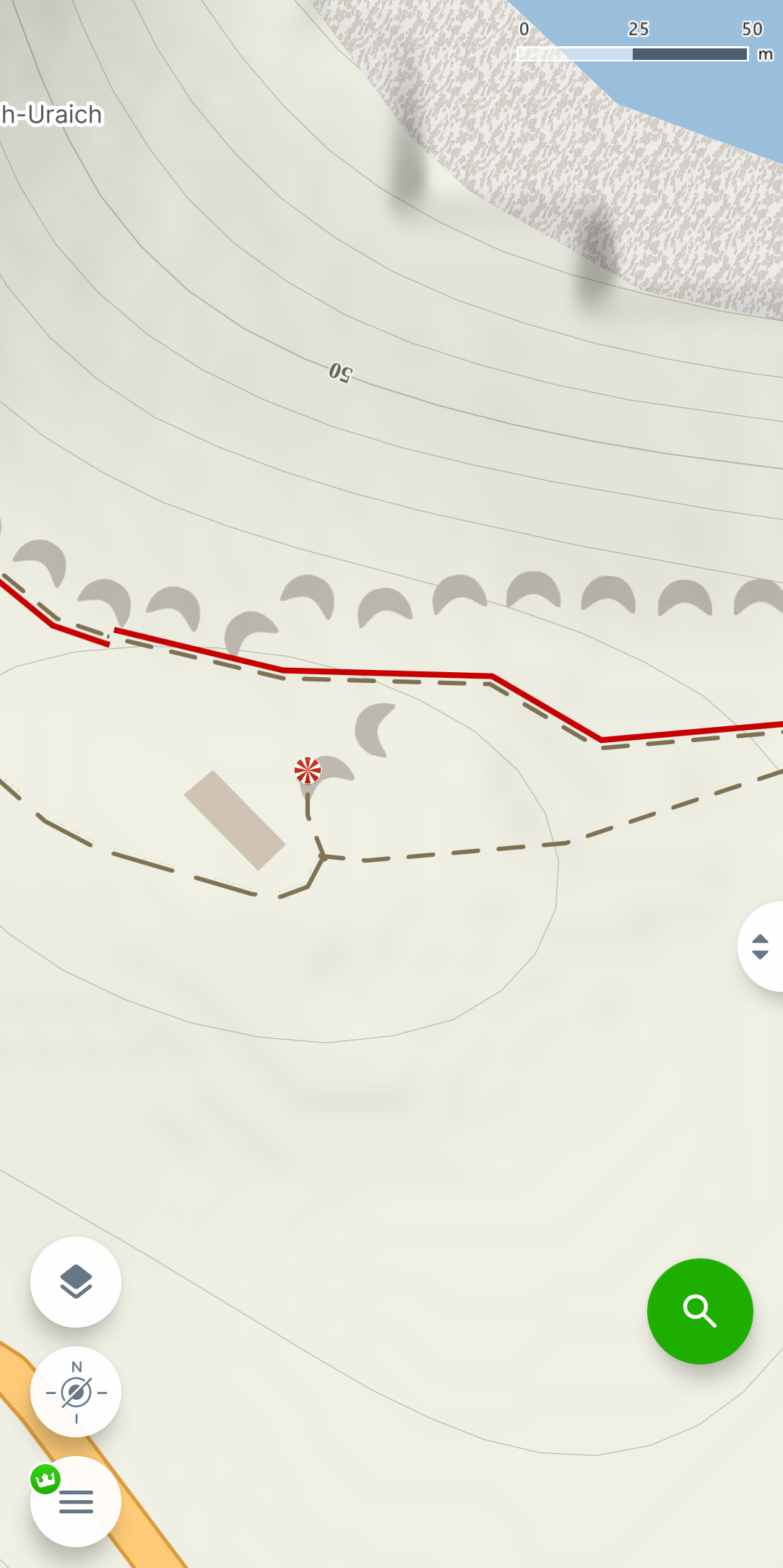
This is just a sample area containing the features I’m writing about. I don’t remember if it was the exact same location, probably yes. A year ago, I compared maps on the Fenix 8, before Suunto removed many details from the maps.
-
@Tomas5 said in Offline Maps and Routing in Suunto App:
@pavel.samokha btw is there technical reason why offline and online maps differ? For example offline maps in google maps or in mapy.com are identical to online version if i am not mistaken.
Different data source
-
@Stefano-M64 said in Offline Maps and Routing in Suunto App:
The offline map styles looks a bit too “cartoonish” to me, the lines thickness is larger than the online ones, resulting in a less clear graphic. Here, for example, small water flows (torrents) that are nearly invisible in the online maps are plotted so wide to nearly hide the hiking paths in the area
As I already mentioned above offline map styles are based on the watch styles and suboptimal for bigger screen, it will be improved
-
@bobbyfw03 it’s really good, to have it back as it already was for years. … so now we can repeat the old request to make the whole route “clickable” etc

-
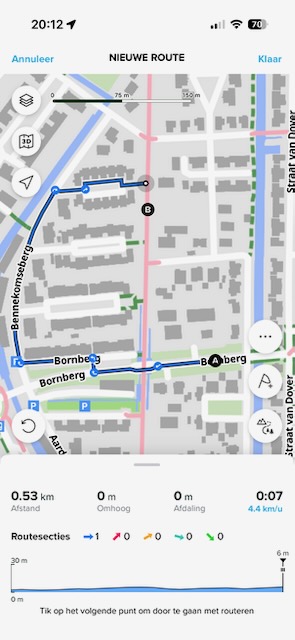
Sure, here are two screenshots of a route created based on the same points and the same route mode (all trails, all roads). One is with the online maps and the other one with the offline maps. The red way is tagged as highway=cycleway in OSM.
Offline maps:
Online maps:
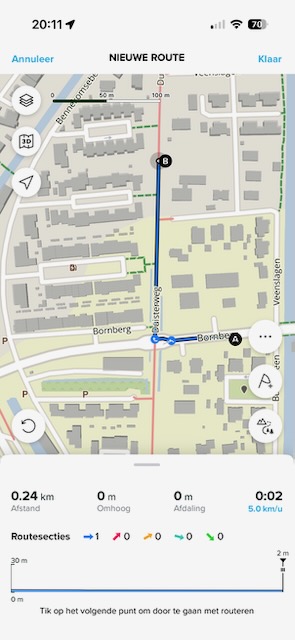
If you need more info, please let me know.
-
@JungleJim yes, location would be useful
-
@pavel.samokha location is in the Netherlands, the coordinates of the starting point A from the screenshots are 52.192754, 5.413624.
-
@pavel.samokha Are there any plans to add the names of the POI if I click an it while being in offline mode? Or at least that I can search for them? When I’m in a new city I like to do some exploration run and it would be nice if I could search for the POI names and plan my route through the city.
Today I can’t get more information to the visible POI in offline mode (this one shows POI „clearer“ than the normal maps) nor can I search for some points I can see on the map in offline. E.g. I’m visiting Rome now and would like to plan my route to the Saint Peter‘s Square- one of the most popular places. I don‘t get a match in suunto when searching for it but can see it in online and offline mode as POI. Are there any plans to expand this kind of search? Edit: Links to pictures -
Poor rendering of offline maps at zoomed out levels - it is almost impossible to see the trail system as a whole to make an intelligent routing decision because trails are obscured by contour lines. I really don’t understand why trails get the lowest priority in terms of readability - both on the watch and now on the app offline maps.
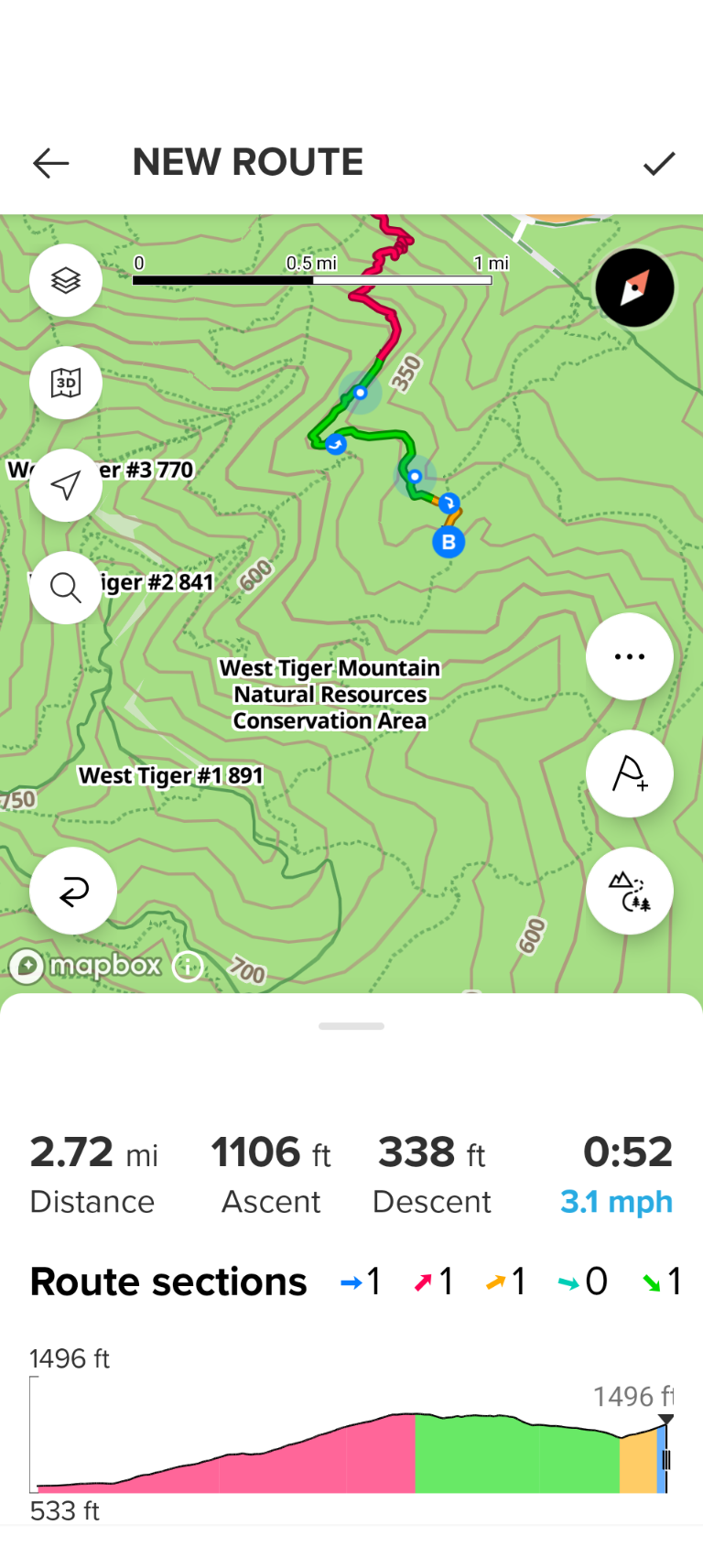
Also, by the way, the altitude is shown in meters on the contour lines even for US users. That isn’t a big deal for me but may be a bigger issue for other US users.
Suunto: Ambit, Ambit 3 Peak, 9 Baro, Race S, Race Ti, Vertical 2 Ti
Garmin: Forerunner 210, Forerunner 610, Fenix 6X, Fenix 7X Ti -
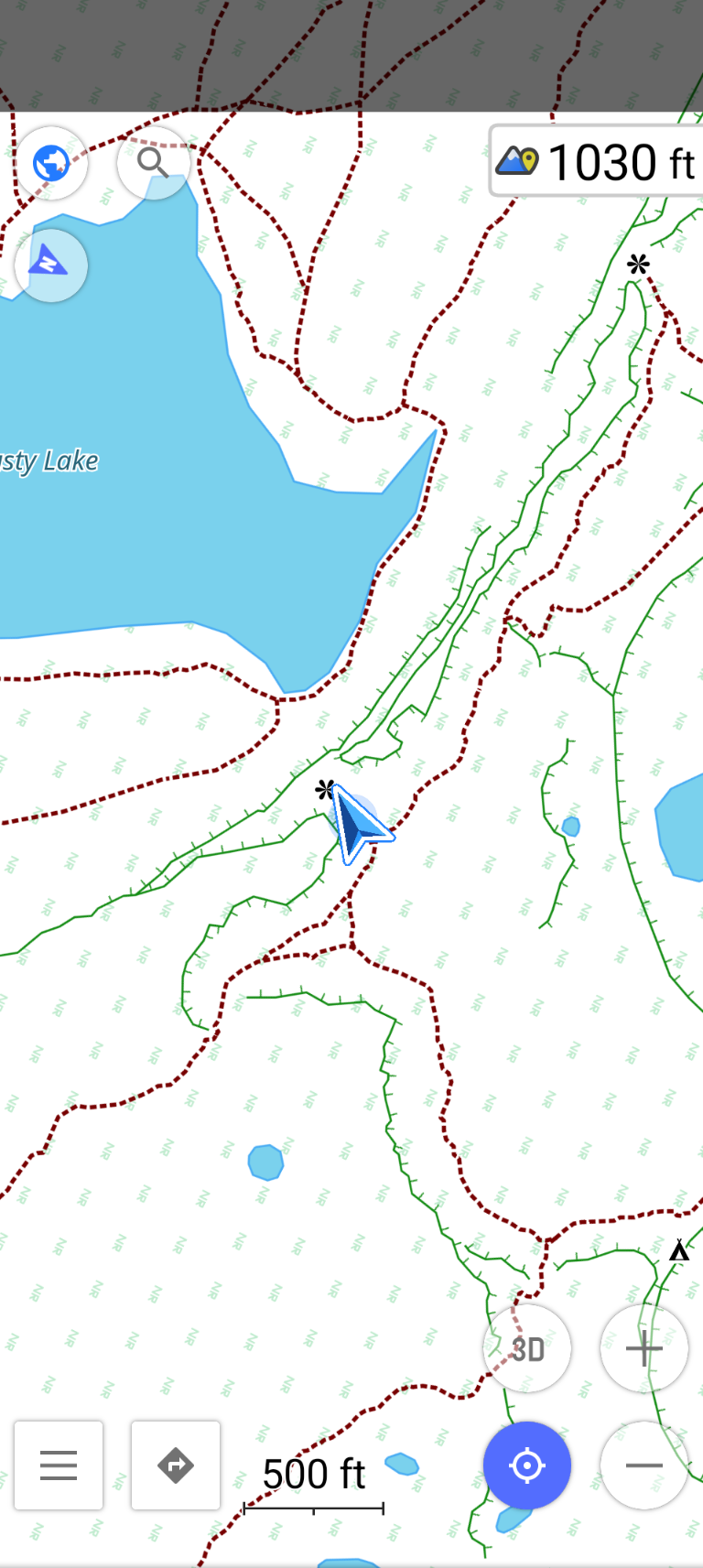
And here is an example of much better rendering of the map that is actually very easy to read on the go - this is OsmAnd app. Also note that most of the app icons are semi-transparent and don’t obscure the map details as much.
-
@pavel.samokha said in Offline Maps and Routing in Suunto App:
@Tomas5 the reverse case is:
I’m somewhere in mountainous not very populated area and I’m searching where to park before going on a hike.
Quite likely there will be also a parking without any explicit tags. Putting it on highest zoom levels will be inconvenient - hard to find, as I will need to scroll a lot.
I’m not arguing it looking overcrowded in the city, but explaining the tradeoffs here. I will think what else we can do
While this may sound practical in theory, I wonder who is using their watch screen while driving a car towards the trailhead.
I think noone.
While driving I use the car’s built in navigation to find a parking spot. So parking places on watch screen is really not necessary.
Thanks for listening.t6, S6, Elementum Terra, Ambit 3 Sapphire, Spartan Ultra Copper, Traverse Alpha, S7 Graphite LE, S9B Ambassador, S9P Titanium, S9PP Titanium, Vertical All Black, Race Titanium Charcoal, Race S Titanium Courtney, Run Lime, Race 2, Vertical 2 Titanium
-
I accidentally exited the SA app and, when I logged in again, lost all the offline SA maps I had downloaded. Is this a known issue? SA v. 6.8.9
-
@Egika said in Offline Maps and Routing in Suunto App:
While this may sound practical in theory, I wonder who is using their watch screen while driving a car towards the trailhead.
I think noone.We are talking about offline maps in Suunto App in this thread. Consider the following use case. Let’s say you want to bail out from the hike or trail run and find the shortest path back you your parked car. This might not always be retracing your path back, especially if you are doing a loop route. If the car is parked at a trailhead or a parking lot, seeing these symbols on the map would give an important context to help figure out where the car is.
Alternatively, even a better solution would be to be able to see an activity that is in progress on the map in the app. That would clearly show where the beginning of the activity was.
I’ve actually had a similar experience a few weeks ago. I wanted to use Suunto App to find the shortest path back to the car and start navigation on the watch from the app, and figuring out where I needed to navigate to wasn’t obvious at all.
Suunto: Ambit, Ambit 3 Peak, 9 Baro, Race S, Race Ti, Vertical 2 Ti
Garmin: Forerunner 210, Forerunner 610, Fenix 6X, Fenix 7X Ti -
@sky-runner It’s hard to call a map readable without contour lines.
-
@maszop said in Offline Maps and Routing in Suunto App:
It’s hard to call a map readable without contour lines.
I disagree for two reasons.
-
There is an elevation profile at the bottom. You can interactively try to route along the path and see how the elevation changes, and if you don’t like that, it is easy to undo. Paper maps don’t have this interactivity - that’s why contour lines are more important.
-
Contour line are sometimes helpful, but they should not dominate the view to the point where they obscure other important details, and that’s what we see in my screenshot. Also that long text that tells me I am at West Tiger Mountain Natural Conservation Area. I already know that. With contour lines, the same usefulness could be achieved by using less contrast thiner lines - the brain would still pick it up just fine. What I want to see primarily is the trail system to make a routing decision. An ideal solution would be to toggle contour lines on/off - that’s what I can do in OsmAnd app, but most of the time I don’t really need contour lines even though I likely do more ascent and descent every week than most people in this forum.
-
-
@sky-runner Such pictures look nice on the forum, but in the real world, where most of the area is without trails and roads, such maps are of little use, and often even useless.
-
@sky-runner ups. Sorry.
-
@maszop Ok, here is another screenshot from the same app with countor lines - the same area as the original screenshot of the Suunto app offline map. Arguably, it is still much clearer and easier to read. The app actually has a whole bunch of map rendering configuration settings - it allows me to choose the density of contour lines, their thickness and when their color.
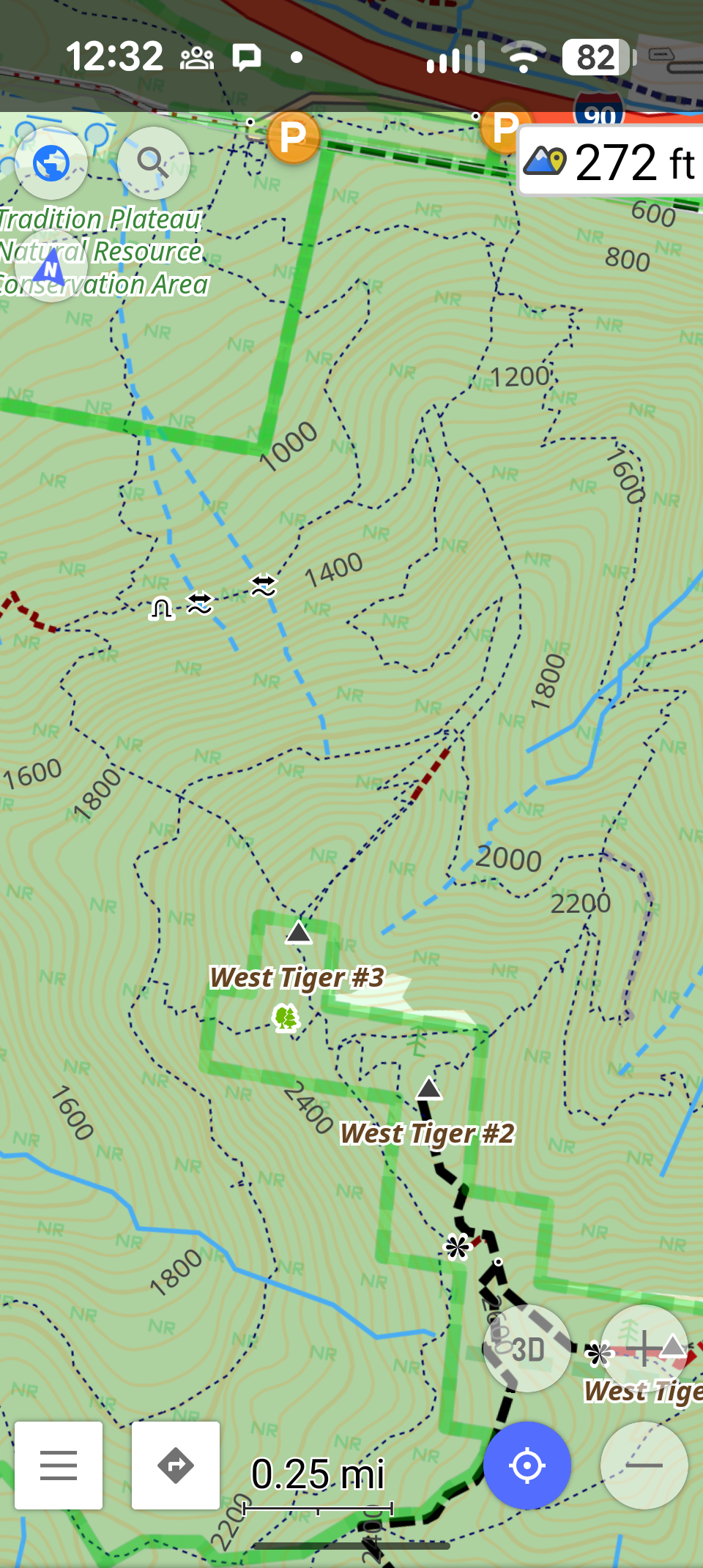
I don’t day Suunto app has to have the same level of customization, although that would be nice, but at less the rendering of contour lines and labels should be more balanced with the rendering of trails.
-
@sky-runner You’re overcomplicating simple things.
Contour lines on online maps are very clear and non-intrusive (they don’t ruin the map’s readability) without any switches or other unnecessary mechanisms.




Hello! It looks like you're interested in this conversation, but you don't have an account yet.
Getting fed up of having to scroll through the same posts each visit? When you register for an account, you'll always come back to exactly where you were before, and choose to be notified of new replies (either via email, or push notification). You'll also be able to save bookmarks and upvote posts to show your appreciation to other community members.
With your input, this post could be even better 💗
Register Login