Suunto 2.50.26 – Q4 2025 Release Notes
-
@DrSilverthorn „ In comparison to running or rowing, cycling uses less muscle, so local muscle fatigue usually occurs before cardiopulmonary exhaustion.“
-
This Q4 2025 Suunto update looks huge! The multisport focus is impressive—automatic transitions for Triathlon and SwimRun, circular multisport, and the new ZoneSense features will make training so much smoother. I also love the per-sport persistent settings and the improved optical HR algorithms—it should finally feel closer to chest strap accuracy. The navigation and sensor improvements are a nice touch too, and the demo mode is perfect for in-store use. Overall, seems like a solid upgrade for both casual and serious athletes.
-
@DrSilverthorn I completely disagree! Zones will change for sports but HR Max is a single value, period! This is physiology.
Vector/T6c/Vertical 2 Ti
-
I managed to initially test the new software in relatively poor weather. Calculating elevation gain in moderate winds finally worked very well. At least, during moderate winds.
And as I mentioned earlier, none of the bugs I’ve been reporting on for many updates have been fixed. Specifically, the inability to change routes during ascent/descent, the crazy breadcrumb, and the occasional lack of updating of the current position on the map.
-
Hi everyone, thanks for your input. I’ll enter my maximum heart rate achieved in both sports, but I’ll configure different ranges for each discipline since certain muscles or physical qualities are more involved. Thanks for your contributions.
-
@Brad_Olwin go back and read my original post. We are in violent agreement. That being said, using a single HRmax value for purposes of training load computation, when using multiple sports is suboptimal, and IMO ‘wrong’.
Suunto Race Ti, Vertical Ti, Vertical 2 Ti, Garmin Enduro 1/2, Polar VV2
-
@DrSilverthorn Its not the HRmax that is used for Training Load in my experience, its the zones - especially the thresholds. And those you can set per sport
-
@DrSilverthorn agreed.
Heart-rate–based training load metrics rely on normalizing effort relative to a reference such as maximum heart rate, implicitly assuming that a given percentage of HRmax represents a comparable level of physiological stress. In reality, HRmax is sport-dependent, varying with muscle mass involved, body position, contraction type, and neuromuscular recruitment; most athletes reach higher maxima in running than in cycling or other seated sports. Applying a single HRmax across multiple sports therefore misaligns intensity zones, systematically under- or over-estimating load for at least one activity and biasing cumulative metrics like weekly or chronic training load. This error is not random but structural, making cross-sport load comparisons unreliable and increasing the risk of hidden fatigue. For multi-sport training, sport-specific HRmax values or preferably sport-specific thresholds are required for physiologically defensible load estimation.
SR, SVti (Mammut Edition), SR2, Suunto Wing
-
@BastMaSVSRS9PP said in Suunto 2.50.26 – Q4 2025 Release Notes:
@DrSilverthorn agreed.
Heart-rate–based training load metrics rely on normalizing effort relative to a reference such as maximum heart rate, implicitly assuming that a given percentage of HRmax represents a comparable level of physiological stress. In reality, HRmax is sport-dependent, varying with muscle mass involved, body position, contraction type, and neuromuscular recruitment; most athletes reach higher maxima in running than in cycling or other seated sports. Applying a single HRmax across multiple sports therefore misaligns intensity zones, systematically under- or over-estimating load for at least one activity and biasing cumulative metrics like weekly or chronic training load. This error is not random but structural, making cross-sport load comparisons unreliable and increasing the risk of hidden fatigue. For multi-sport training, sport-specific HRmax values or preferably sport-specific thresholds are required for physiologically defensible load estimation.
Tell that to Coros and his “One HR zones for all”…
-
@BastMaSVSRS9PP said in Suunto 2.50.26 – Q4 2025 Release Notes:
Heart-rate–based training load metrics rely on normalizing effort relative to a reference such as maximum heart rate, implicitly assuming that a given percentage of HRmax represents a comparable level of physiological stress.
Possibly this assumption of percentage of HR max is used as the reference isn’t correct after all? If Suunto uses HR zones for training stress calculation, then those are the reference…
-
@jjpaz Or see Polar’s implementation where you can set maxHR and zones for each sport profile.
This is the way to go.
I did a stress test in a laboratory on a bike and my maxHR was 10 beats lower than during a running session. My cardiologist assured me that this was normal because cycling is a low-impact sport that does not engage as many muscles as running. -
@Raphes67 yeah, but it is the maximum HR that you reached by doing that sport not the maximum HR your heart can actually do. The latter one keeps the same.
-
@2b2bff yes you’re right, I have a physiological max heart rate that is reached during running (in my case 184). But when I cycle, I know that I can never reach this max heart rate and 174 would be my max for this sport. That’s why for any cycling profile I have to set a different max heart and different zones according to this knowledge to reflect the real effort and recovery metrics that are dependent.
-
@Raphes67 so what is the problem? MaxHR is maxHR that is the limiti, also Suunto allows to change cycling zones to reflect your ability to only reach lower HR for cycling.

-
@aiv4r
Hi, in this latest update (in my particular case), when you change or modify the Maximum Heart Rate for cycling, it also modifies the heart rate for other sports (running, default, etc.). This could be a bug to consider. I think I’ve modified it in previous updates, and each sport had its own custom heart rate zones…
Hence all these tips, contributions of maximum heart rate in different disciplines… -
@Elmiuel yea I do not think it is a bug, maxHR is maxHR and I think suunto focus on one physiological maxHR (it is only one). So when changing zones in cycling just change zone limits themselves not the mac HR. I think it is supposed to work like that.
-
I use customized sport modes and in two of them I want to be able to see “Lap Duration” while exercising:
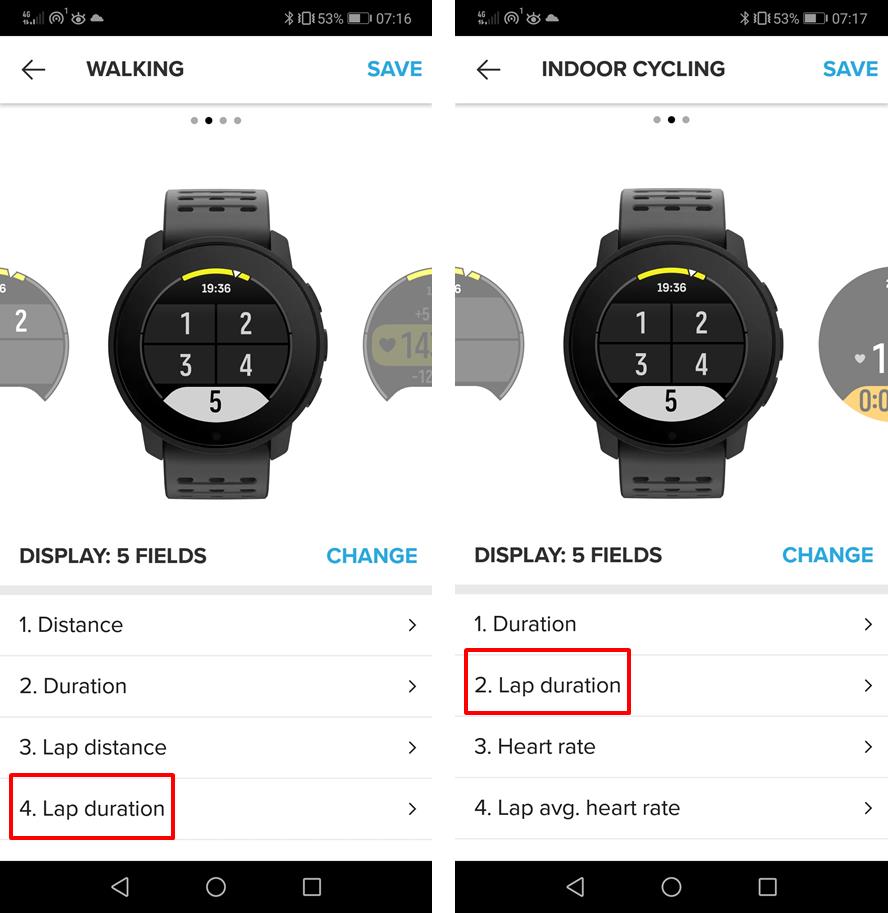
Up until this latest update it has worked fine, but now I get no real-time lap data on the watch (9PP) when in spinning class (Indoor cycling). It does, however, work correctly in the Walking sport mode. When spinning, I start new laps when transitioning from warm-up to exercise, and then again when transitioning from exercise to cool-down. Yet no matter how many new laps I start Lap duration continues to be equal to Duration. Curiously, when I synch with SA I can see the duration of each of the three laps in the app, so the data is being recorded correctly in the watch, just not displayed real-time on the watch.
Is this a bug? Is anybody else having this problem?
-
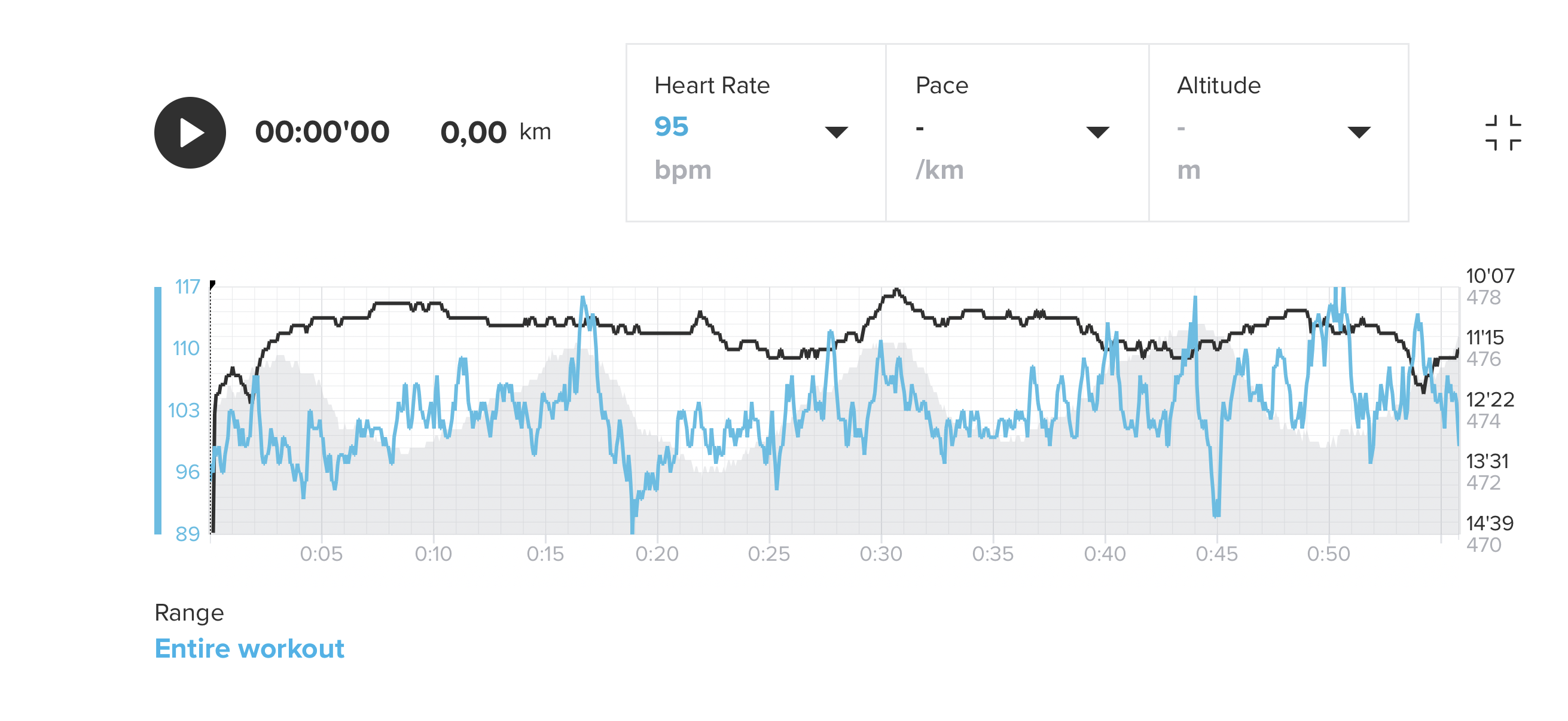
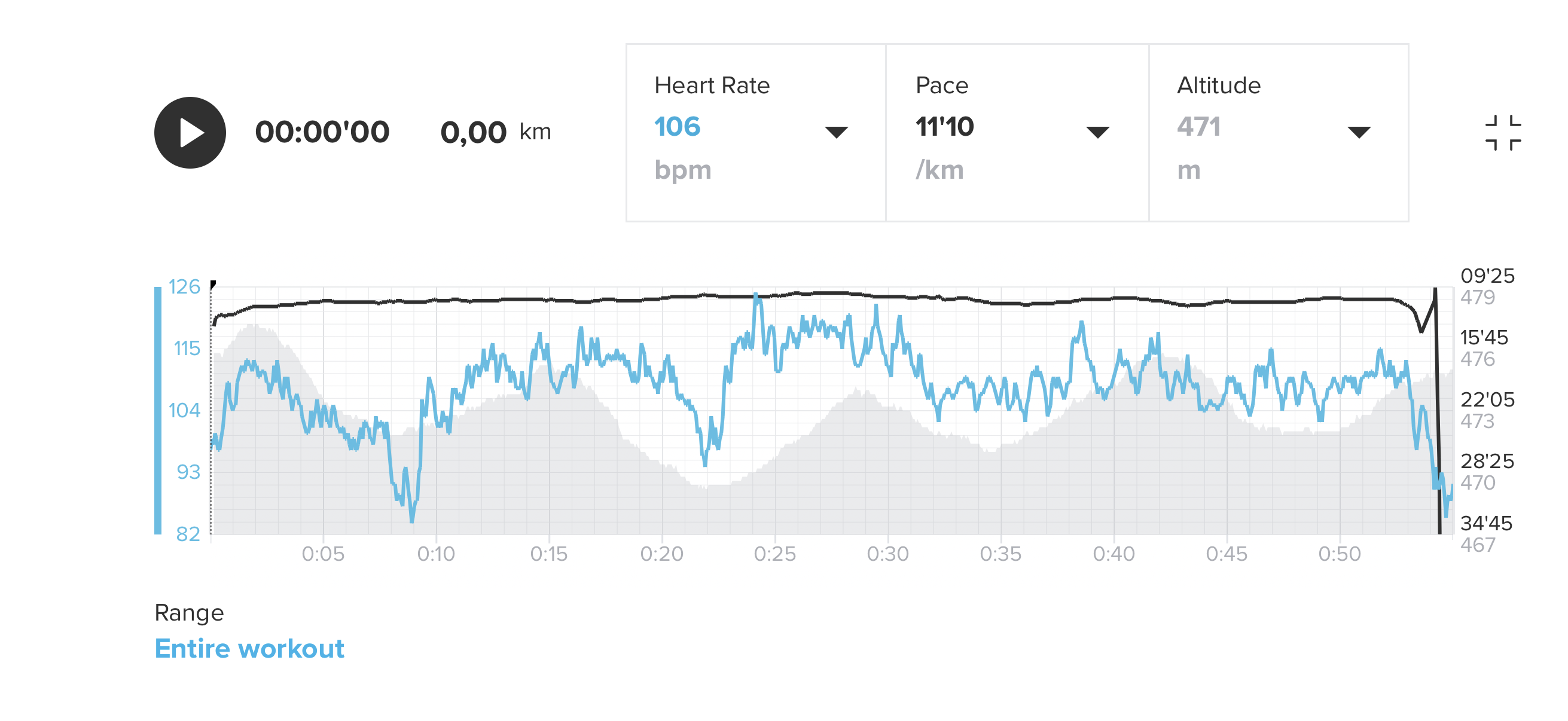
I don’t know whether there is any change for vertical 1 on the oHR … but on Thursdays I walk around a path waiting on a relatively steady pace … some times I record it … same watch , same strap , similar conditions , properly worn … but look at the oHR variability with the new firmware … I have never seen anything like it
New one
Old one
-
@thanasis do you have a chest strap for measuring HR? I have one, maybe this weekend i can do a test with:
OHR with new firmware (Race S here)
Chest-strap with stravaand record with both application the same exercise, and let’s see how far the HR measurements are drifting?
-
@brechtvb yes I have and using them when needed (running , trailing , tennis etc ) but not for walking .
But having such a volatile numbers is somehow odd to me








Hello! It looks like you're interested in this conversation, but you don't have an account yet.
Getting fed up of having to scroll through the same posts each visit? When you register for an account, you'll always come back to exactly where you were before, and choose to be notified of new replies (either via email, or push notification). You'll also be able to save bookmarks and upvote posts to show your appreciation to other community members.
With your input, this post could be even better 💗
Register Login