Sleep analysis
-
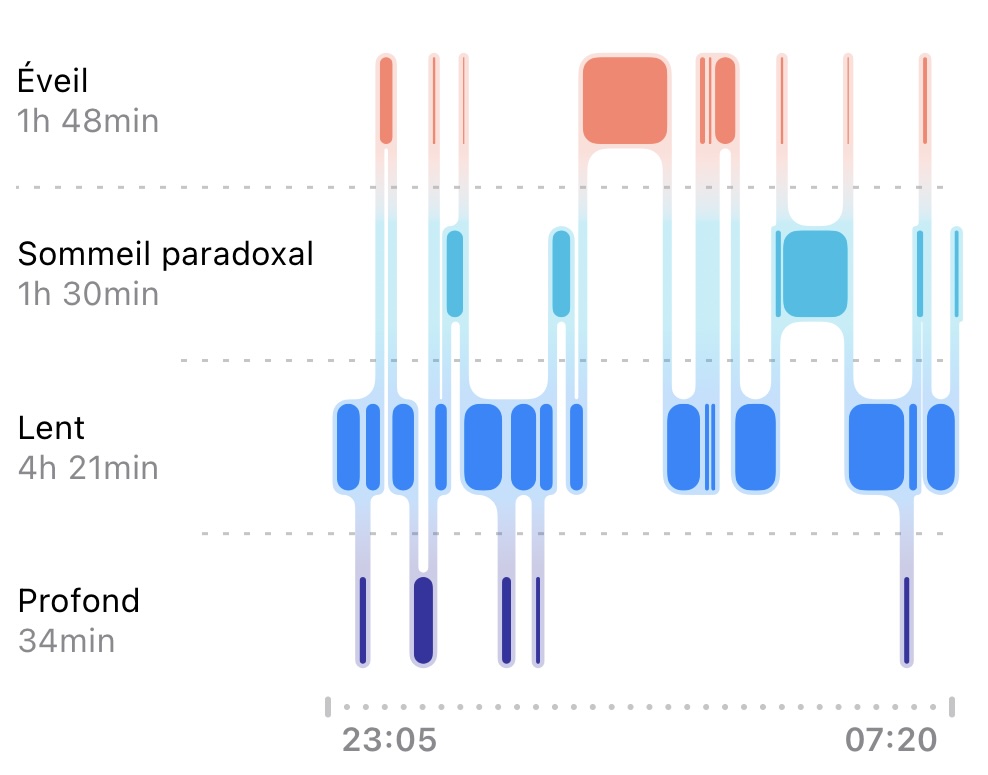
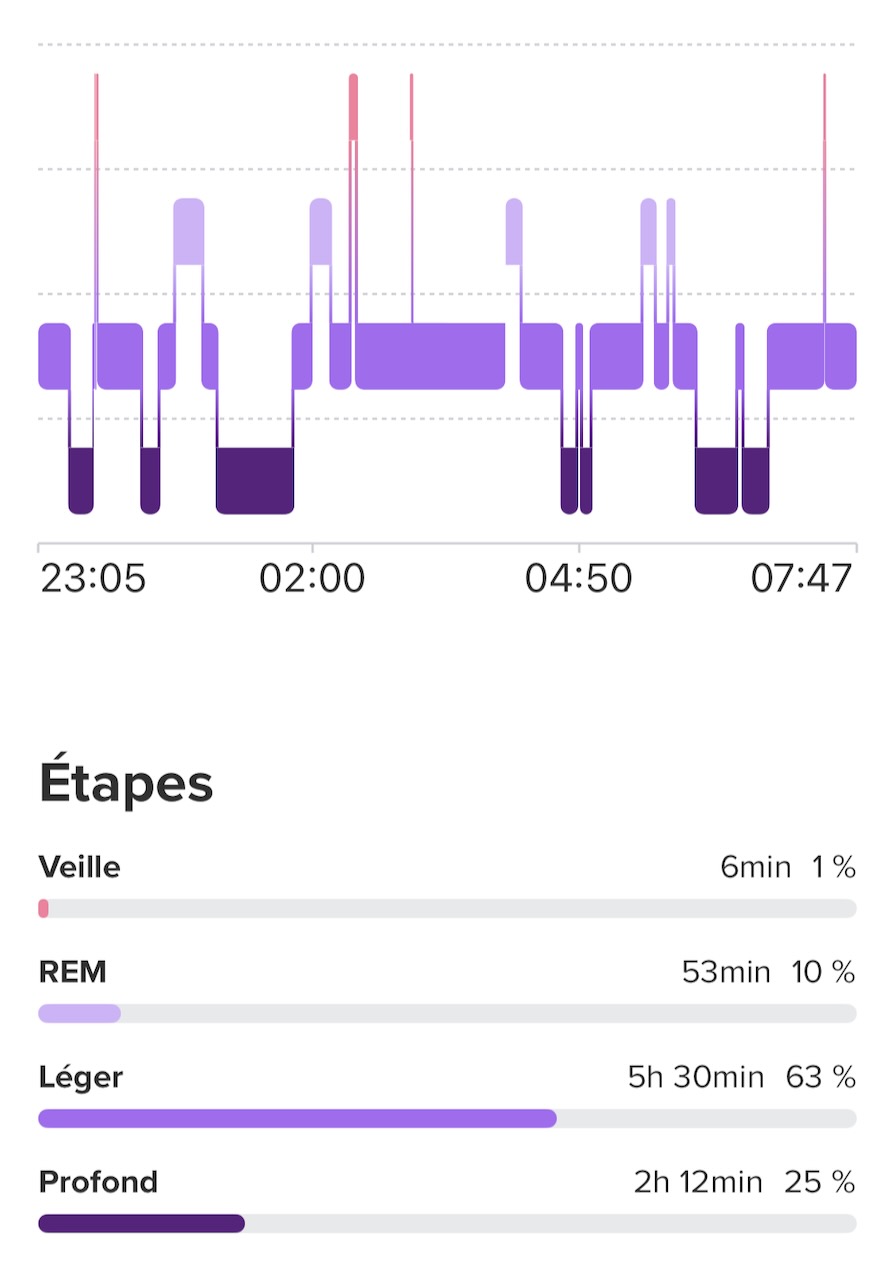
I am currently testing the Suunto Run and the Apple Watch SE 2 during my sleep. And as much as I am impressed with the precision of the Apple Watch, the Suunto Run is completely beside the truth. Example of the last sequel which was a bad night and during which I got up around 2 a.m. because I couldn’t fall asleep. The Apple Watch perfectly detected this period while the Run thought I was sleeping. The problem with this false data is that the recovery is based on this false data and therefore the recovery is also false. The sleep score on the iPhone is “Passable” with a 0 out of 20 on interruptions and on the other side Sunnto announced a “normal” recovery. What do you think?
-
@ADidier one thing that I noticed is that my score is consistently 79% (around 8/10 times) or a very close number in the app. No score is given on the watch which is weird. The algorithm needs some polish for sure.
-
@ADidier I guess it depends on what you are using the data for… I pretty much ignore sleep analysis. If I sleep poorly I know it, if I sleep well I know it. Then when I exercise I do not use a device to tell me how hard I can exercise. If I have an interval run scheduled and I am tired and don’t feel I can perform the interval to achieve the desired intensity and get the training benefit I will defer to another day.
Personally I think relying on devices to tell you how well you slept, how you feel and how recovered you are is ludicrous. Sorry, my opinion only, not Suunto’s or anyone else’s.Vector/T6c/Vertical 2 Ti
-
@Brad_Olwin
Because of everything you wrote I left Garmin. Now I use Suunto run and the only thing that matters to me is that it has an accurate gps. -
@Brad_Olwin I double that.
-
@Brad_Olwin I don’t agree with this view. If the feature is there it should work. Or do you buy a car with air conditioning but if doesn’t work it’s ok because you can open the windows?
Suunto has a much less “fatigued” set of features compared to Garmin and I like it but the one’s they put on their watches should work with minimal accuracy.
-
@Brad_Olwin said in Sleep analysis:
@ADidier I guess it depends on what you are using the data for… I pretty much ignore sleep analysis. If I sleep poorly I know it, if I sleep well I know it. Then when I exercise I do not use a device to tell me how hard I can exercise. If I have an interval run scheduled and I am tired and don’t feel I can perform the interval to achieve the desired intensity and get the training benefit I will defer to another day.
Personally I think relying on devices to tell you how well you slept, how you feel and how recovered you are is ludicrous. Sorry, my opinion only, not Suunto’s or anyone else’s.As ADidier stated, the sleep results can affect Recovery score. Ar you ignoring this metric too, or don’t sleep with the watch, so the Recovery metric doesn’t have that? Additionally the Resources metric also uses sleep data.
If your position is Suunto should completely delete Sleep, Resources, and Recovery metrics from the watch and app, as Suunto users should just “know this” like you do, then that’s certainly a bold position to take.
And hey, I’m not fully opposed to that. Perhaps Suunto should remove these things. Tell people not to sleep with their watch. Tell them to seek answers within, not without. Spend more time developing things that work rather than fixing things people don’t need, if that’s the final analysis of these features.
-
@Nelson-Diogo said in Sleep analysis:
@Brad_Olwin I don’t agree with this view. If the feature is there it should work. Or do you buy a car with air conditioning but if doesn’t work it’s ok because you can open the windows?
Suunto has a much less “fatigued” set of features compared to Garmin and I like it but the one’s they put on their watches should work with minimal accuracy.
The analogy I think Brad is using is “I always drive with the windows open, so don’t need air conditioning,” and this leads to the collaborative thought “and if people want to be cooler, then they should open windows, not turn on air conditioning.”
-
@Brad_Olwin Here here to all of what you said! In some respects, I’m tempted many times to turn OFF much of the detailed analysis features and just go by feel, and use watches for time and distance data (which dual band GNSS has made scary accurate!).
I had someone tell me when I first started running to learn to run by feel, and specifically to go to the extreme at times of literally covering the watch screen with tape (a little harder now with touch lol) to force myself to focus on the run, not the watch. I haven’t followed that as much as I probably should, but just like other posts I’ve made across this forum in recent days, there’s a point that simpler is better. And even with sleep data, my personal take has become more and more to use it as a reference for long term trends, rather than a detailed to the minute view of a particular night.
-
@raven i wonder how people were doing sports before smart/sport watches when they did not know how much resources they had

But I partly agree with you that we should not have features that does not work, but we are not there withh all this smart watches boom, since some things are just “good enough”, Garmin is a clear example of that with million scores that had inaccurate and even sometimes unscientific data behind it, but it is accepted by the community. Sleep analysis are not accurate on all devices, but everybody uses it. Yes it could be better at detecting wake up times and total sleep time, but it is hard to make an algorithm that is as good for all users.
Resources and Recovery might be made up using sleep data but it depends to what degree. But I cannot comment on those since I do not look at it and have it removed from all my widgets.Suunto Race 2 (Titanium Trail)
Suunto Vertical (Titanium Solar Forest) -
@Nelson-Diogo said in Sleep analysis:
@Brad_Olwin I don’t agree with this view. If the feature is there it should work. Or do you buy a car with air conditioning but if doesn’t work it’s ok because you can open the windows?
Suunto has a much less “fatigued” set of features compared to Garmin and I like it but the one’s they put on their watches should work with minimal accuracy.
I’m 54 years old and have been running since I was 9. So I know myself very well: I can tell if I’ve had a good night’s sleep and how to adjust my workouts accordingly. I like to analyze my data and compare it to how I feel.
I completely agree with Nelson: the features Suunto includes in its watches are optional, and there’s no obligation to use them. However, the least we can expect is that they be reliable—which, unfortunately, isn’t the case here.
*** Translated with www.DeepL.com/Translator (free version) *** -
@ADidier
Ja schade dass die wachzeiten immer noch nicht richtigr egistriert werden…sie werden fast gänzlich mit leichtschlaf ausgepügelt…dass ist do schade so habe ich immer 30-60 min täglich mehr schlafzeit als ich eigentlich geschlafen habe…dass ist so schade und verzehrt die ganzen Erholungs und Ressourcen werte…ich hoffe so stark dass suunto dieses Problem löst… weil der sportuhr teil ist weitaus der beste von allen anderen… -
@Thaler-Martin Could you please use English as it is the forum language? I believe it is easier nowadays with all the tools we have. Thank you.
-
@aiv4r said in Sleep analysis:
@raven i wonder how people were doing sports before smart/sport watches when they did not know how much resources they had
My first sports watch was the Garmin 910XT which didn’t have any of this recovery elements. So I’m serious when I suggest perhaps Suunto doesn’t need these metrics, especially if they are going to be error-prone, and when those errors are mentioned, the advice is to ignore these metrics altogether. Why not pay less money for a watch that has only the features that work?
-
@Thaler-Martin said in Sleep analysis:
@ADidier
Ja schade dass die wachzeiten immer noch nicht richtigr egistriert werden…sie werden fast gänzlich mit leichtschlaf ausgepügelt…dass ist do schade so habe ich immer 30-60 min täglich mehr schlafzeit als ich eigentlich geschlafen habe…dass ist so schade und verzehrt die ganzen Erholungs und Ressourcen werte…ich hoffe so stark dass suunto dieses Problem löst… weil der sportuhr teil ist weitaus der beste von allen anderen…I’ll translate, or rather, my device will: “ Yes, it’s a pity that the waking times are still not properly recorded…they are almost completely cleaned out with light sleep…that’s a pity so I always have 30-60 minutes more sleep time a day than I actually slept…that’s such a shame and consumes all the recovery and resource values…I hope so much that suunto solves this problem… because the sports watch part is by far the best of all the others…”
-
@raven i fully agree with you, I would glady pay less for Suunto without AI coach and resources and recovery stuff, I am fine with sleep detection, since it is nice to follow HR and HRV trends during the night. But other than that there are not many watches left that does not have this. Coros so far stay little immune from nonsence, but for how long, because market clearly want these features.
-
@aiv4r said in Sleep analysis:
@raven i fully agree with you, I would glady pay less for Suunto without AI coach and resources and recovery stuff, I am fine with sleep detection, since it is nice to follow HR and HRV trends during the night. But other than that there are not many watches left that does not have this. Coros so far stay little immune from nonsence, but for how long, because market clearly want these features.
It’s tricky. I do value overnight HRV, for example, and I also like knowing both total sleep time as well as interruptions. Sometimes my body wakes me in the middle of the night, and sometimes my cats do. While I have some idea of this duration the next day, I’m not going to write down notes on it, so it’s good I have devices that can do this. I don’t generally need this data but occasionally I do.
Last year I had an injury while weightlifting and needed some therapy and a few weeks recovery time to get back on track. The first few days after the injury I couldn’t sleep at all, averaging less than two hours uninterrupted sleep at a time. Having sleep data for this recovery period was good for me, as I shared it with my doctor for analysis.
However, the data I used was from Apple and not Suunto. Apple more accurately notes my sleep interruptions and Suunto tends to ignore them. Meanwhile, Apple only records HRV a few times a night, and (I hope) Suunto does more sampling. This is difficulty to say, as I get an overnight average for HRV, but as far as I know, there’s no way for me to find how many samples were taken and those individual values. Right now I wear both devices as it’s not a bother to do so and I might find the data interesting. Do I need the data? Not especially, most of the time. When I do look at it though, I want it to be as correct as possible.
Overall though, my thoughts are sleep data in general doesn’t need to be part of my main watch. Garmin has a “Garmin Sleep Index” screenless device meant only for night use. It seems to me more companies should do this. For example, Apple were to release such a thing, then Apple Watch users could use that for sleep, and this would immediately solve any battery life issues people have with that for say 90% of the population (only ultra endurance people, etc. would still have a quarrel in my mind). What Garmin doesn’t have yet is a “day only” watch that doesn’t try to do sleeping (pointing people to the index) at a cheaper price point.
So “divorcing” sleep metrics from the main watch seems reasonable to me. Have Suunto day watches meant for tracking your main sessions and daytime activity. Take it off at night, and for those who want overnight data, put on a secondary device that does this better with ideally pristine metrics. There’d be no call to ignore sleep data for a sleep device like we see in this thread.
-
@ADidier I totally see your point. However, I think sleep tracking is hard. It took Apple forever to roll this out and they have a huge user base. Clearly I think Apple leads the pack here. Suunto has a touch choice, either do what the market demands or lose sales. I would rather a company, any company get it right maybe with less features so no deep, REM and light but absolutely accurate sleep times. I agree with you, I would use that if I knew it was always correct.
-
@Brad_Olwin @aiv4r I completely agree with you.






Hello! It looks like you're interested in this conversation, but you don't have an account yet.
Getting fed up of having to scroll through the same posts each visit? When you register for an account, you'll always come back to exactly where you were before, and choose to be notified of new replies (either via email, or push notification). You'll also be able to save bookmarks and upvote posts to show your appreciation to other community members.
With your input, this post could be even better 💗
Register Login