How are so many basic features missing? Are these on the roadmap?
-
Instead of pausing an activity, allow someone to go to their exercise log, then choose to extend an existing saved session.
As soon as activity is saved it gets pushed to the cloud and other platforms such as Strava or Training Peaks. So this approach won’t work or it would become very complicated to manage.
Personally, when I owned Garmin have have never used “Stop and Resume Later” feature. Heck, I don’t even pause my watch except in rare cases. On Suunto I prefer to have raw data and on Strava I let Strava automatically remove stopped time (unless it is a race). And if a stop is extended, for example for lunch, I simply end activity and then start another. In a multi-day case, I definitely use separate activities for each day. I see an activity as a single effort as opposed to a single GPX track.
-
@elbee Let’s approach this another way; we can define two types of devices. A “sports watch” should simply record an activity/session and that’s it. A “smart watch” does additional things outside of activities.
As an example of the former device, my first GPS wrist device was a Garmin Forerunner 910XT and I’d call it a “sports watch” as defined above. I used it when I did my sessions, and turned it off completely and took it off my wrist when not in a session. It was simply too big and bulky to be used as a timepiece.
It seems that’s more in spirit with what you want, if you see features sleep tracking as a distraction, and feel Garmin has gone too far on extraneous non-activity features. If so, I’d submit Suunto’s current design, where when an activity is paused the device is effectively frozen, is more in the “sports watch” mindset. You’re either currently tracking an activity or you’re not. If you are paused and having lunch on a bike tour, then you likely have a smartphone with you, which can do all the minor non-sports things your Suunto device can do like checking the weather.
For my “sports watch” vs “smart watch” distinction, I do think asking to do anything other than activity tracking leads to a slippery slope of non-sports features, some of which we’d likely all agree are expected in 2026, and some of which we’d say are superfluous. I keep using “watch” and “device” here sort of interchangeably, because I do think simply telling the user the time is now considered a basic sports watch feature. Likewise, I think showing weather is non-controversial for most people, and we can see how it’s “sports related” and useful.
After that, things like music control, showing messages, showing calendar events, etc. can easily push into “smart watch” territory. I like to have music when I run, but can agree it’s not a basic sports watch features, and back in my 910XT days I had an iPod to accomplish this.
However, the area of “wellness” like tracking resting HR, sleep, and other non-activity but body-related aspects of our lives I think has slowly creeped into the “we expect this by default” area, pushing those feature more into “sports watch” rather than “smart watch” despite the fact the 910XT never did such things.
I’d suggest if Suunto’s current pause behavior were to change, so that you could do something else when paused, then the natural thing people would expect is “I should be able to do everything I could do before I started the activity,” so open any other widget/app on the device.
I’d say this should also include starting another session as that’s normal device behavior with the only stipulation being cannot have two activities paused so the secondary session would need to be properly ended before doing anything else. Effectively, the second session would gave the current “device is frozen on pause” behavior we have now.
So for a “purist, I want only a sports watch, not a smart watch,” I think the current pause ability is generally fine. It’s certainly not great for a smart watch though.
-
@elbee I appreciate the reasoned discussion. Another question, if you know, about Garmin — you mention you cannot run another activity while one is in pause/abeyance mode, but what about sleep? Is that tracking denied too?
The state of paused activity is frozen and stored in memory, GPS turned off, and the watch returns to normal operation. Sleep tracking resumes as normal.
-
@raven
I agree the lines of smart and sports watch are blurring together (in fact Suunto lists battery life for “Daily use: Smartwatch mode” in the battery specs on it’s site). I also agree Garmin has significant feature bloat so they can fill up the spec list on their website. I only used a subset of the features on my old garmin and appreciate Suunto’s cleaner approach. The set of features I describe in my original post here are part of the subset of features I frequently used on my garmin and miss on my Suunto.All these watches are designed for a broad audience and not everyone will use the watch in the same exact way or use every feature available. I did a lot of research before choosing the Vertical 2 but never even thought to check for these features (my fault) because they seemed basic enough to be universal. Going back and searching, I’ve found I wasn’t entirely wrong in thinking so as all the other big names (garmin, coros, amazfit) offer these features.
I posted here hoping Suunto would see it and consider adding these features to their roadmap to meet base feature parity with their competitors. Again these are basic features for me I used all the time, but maybe not used by others.
-
All these watches are designed for a broad audience and not everyone will use the watch in the same exact way or use every feature available. I did a lot of research before choosing the Vertical 2 but never even thought to check for these features (my fault) because they seemed basic enough to be universal. Going back and searching, I’ve found I wasn’t entirely wrong in thinking so as all the other big names (garmin, coros, amazfit) offer these features.
And Polar? It seems most closely aligned with Suunto than the others.
-
I still think it would be much easier – and therefore faster – to implement this in the SuuntoApp rather than in the watch software. You could achieve not only the same results but even more. Plus, you wouldn’t have all the limitations – sleep analysis, recovery, TSS, CTL, ATL, HRV, etc. You could also, for example, use different activities during a multi‑day trek – like swimming, climbing, or via ferrata – without having to deal with complicated activity session management or multisport mode.
Additionally, full freedom of sensor management between different parts of a multi‑day activity.
Reboot, update etc. between days etc.On top of that, it would be available to every user (like ZoneSense), not just those with the latest watches. And you wouldn’t have to pray that a crash doesn’t happen during such long and complex recorded activities.
You could also relatively easily group and combine selected activities into one final one, and then – like with any regular activity – export it automatically to other services, just as it currently happens at the end of every activity.
Especially since, in such a case, it’s really only about the total distance, elevation gain, duration, and a few less important stats like steps or calories. All the other statistics are far more useful on a daily (per session) basis for ongoing analysis. -
@raven
Pause and resume later, not simply pause and resume. Resume later keeps the activity pause in the background -
@raven
Pause and resume later, not simply pause and resume. Resume later keeps the activity pause in the backgroundYes, you told me that on 28 Jun 2026 at 13:52 as shown earlier in this thread. I’m uncertain why you revived this thread to tell me again.
For me, this is a feature I’d never use. If I pause long enough I’m doing a completely different thing for some time (e.g. sleep, have a meal, etc.), then coming back, I’d consider that a new session in all cases.
-
@raven
Pause and resume later, not simply pause and resume. Resume later keeps the activity pausedin the background -
@raven Sorry, not intentional. Must be a bug with the forum.
-
Garmin just announced a feature that, I wonder, may work “better” than resume later, for those who are looking to have a record of a multi-day activity, “Garmin Epic”. This allows someone like me to record as many sessions as make sense (i.e. make breaks whenever I stop) but still have a “holistic view” of a longer trip.
https://www.garmin.com/en-US/garmin-technology/maps-for-smartwatches/garmin-epic/
Quoting from the page:
Garmin Epic allows you to look at a group of activities – and the time in between – to see the full scale of your accomplishments. An epic is more than an activity. It recounts your experience from the trailhead to the campsite and back the next day. It’s how you slept the night before, the hike to your campsite and the way the stars looked when you woke up in the middle of the night to answer nature’s call. Rather than looking at a single day on the slopes, Garmin Epic lets you log and share the entire ski trip. And this feature makes a stage race more memorable as a whole versus as a series of individual bike rides.
-
I don’t see hoe that would be better than “resume later”.
With resume later, my ride/hike with lunchbreak appears as 1 activity on all platforms (suunto, strava, intervals.icu)
What you mentioned only works on garmin. And is focussed on typical garmin users who think more data is always better.
-
I don’t see hoe that would be better than “resume later”.
With resume later, my ride/hike with lunchbreak appears as 1 activity on all platforms (suunto, strava, intervals.icu)
What you mentioned only works on garmin. And is focussed on typical garmin users who think more data is always better.
Some people who asked for “resume later” want to track multi-day activities. I think having a session “in abeyance” overnight is asking for trouble (if software isn’t perfect, the session may get deleted altogether, for example), and for me from a physiological viewpoint a “session” starts when I go from a non-activity state into an activity, and ends when I transition back to my “normal” state. I don’t want a HR graph where let’s say I ran/biked up a mountain to a hillside cafe and my HR is in zone 4 or zone 5, then suddenly that HR graph has me at resting HR after a two hour sojourn. To me that’s two sessions physiologically, and wanting to connect them is more for social reasons than performance analysis.
I’m not saying Garmin has the perfect solution here, but the idea of (1) recording a session as “time moving” with “time not moving” not recorded while also (2) connecting “related” sessions to a larger element makes sense to me.
As for sending to other platforms, to me that’s a separate concern. The main thing I’d recommend for people who don’t want the “individual parts” to get uploaded is to have a system that allows manually uploading rather than automatic, and/or have uploads be private by default. For intervals.icu, that’s not a social platform for me, and my individual sessions are exactly what I want there. I don’t want three days of activities in one report. At that point, why not just do one monthly “session”? For Strava, which to me is more social and I never analyze sessions there, if I were a “multiday person” I’d simply do manual uploads or private by default as noted.
-
Using hypothetical bugs as argument not to implement a feature is a bit strange. Then all software development could better not take place.
And if you don’t want a pause in your ride then don’t pause. Most of us aren’t training for the olympics.
What I read from wishes of others and my experience with garmin, a save to resume later would cover everybody’s needs.
I understand if you say, I have more “important” needs than resume later. That’s fine. I don’t think it is number 1 on my whishlist either.
-
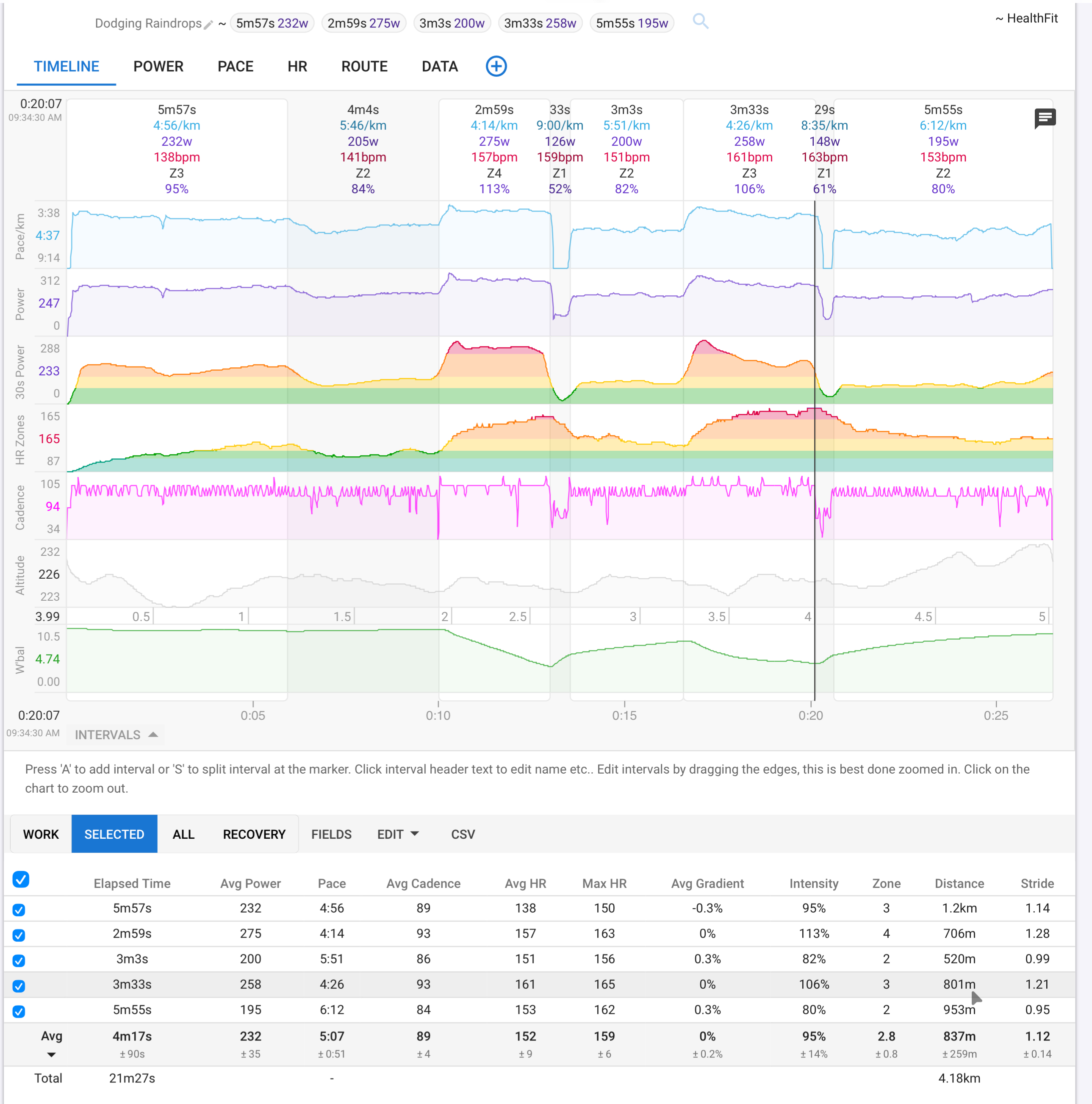
As an example of how I use intervals.icu here’s a recent running session. Let’s say at the end of this session I stopped and had lunch and then started again. That after-lunch effort is starting me from a very different state than I left off at the end of this session, and I don’t see a reason to connect them for analysis. My HR is fairly elevated at the end of this — in my mind, I’d need to first get my physiological state to “return” to this end-moment condition to justify “adding on” more time.
Also note in the middle of this is a 33s walking effort and a second walking effort of 29s later, where I could have paused the session, but then it’d no longer be an accurate representation of how my body handled the overall effort. That time was important to see HR dropping.
-
You made your point you are not interested in resume later. No need to try to convince me. I still see value in the feature.
-
You made your point you are not interested in resume later. No need to try to convince me. I still see value in the feature.
I suppose the analogy I like is someone who is using the handle of a screwdriver to put in a nail. I look at this and think “wouldn’t you prefer a hammer,” but if someone is happy using a screwdriver for this purpose then I suppose not having a hammer means there’s less things for them to be concerned about.
Just because “resume later” does exist doesn’t mean there’s no innovation to be further had, and a future feature may serve someone’s needs better. An example i gave elsewhere is “what if I’m doing a multi-day bike tour, and at night at a hotel stop I want to do some pool swimming?” My understanding of how resume later features work is I’d need to make a choice to keep the resumed cycle ride in abeyance or “close it” to enable the ability to track the swim, or have my ride as a multisport activity (and I’m uncertain if “resume later” can “resume as a different sport” in this hypothetical). in cases like this being able to stitch together sessions may be the “hammer” people don’t know they desired, as they were too used to using a screwdriver to put in their nails.
It’s not that I’m asking you to not see value in “resume later,” and more I’m suggesting the possibility of other features that may work better, but this is unlikely if one is stuck on needing things to work one particular way forevermore.
-
It’s quite simple.
Not every activity I do is about gaining speed or endurance. Some are for fun.
For example, I join a bunch of people to do some trails in France. Some do 10k, some do 30k. All fine.
Halfway we meet for picknick and after that we continue.It would be nice to pause during the lunch, preferably in a way the gps is stopped. Resume later would do this.
Not interested in heart rate. Not in hamers or screwdrivers. Nor in some cutting edge feature that combines data over multiple days. Just a nice social run.
And for me that’s all that there is to say about it.
Should suunto drop everything they are doing to implement this? No. They should stop everything they are doing and start fixing bugs. -
@elbee For your example, “ride for fun” you may not even need to record it at all if you see no value in the data being correct.
Sometimes I take my longboard out and spend an hour skating around, carving and going downhill. I don’t record it as “skating metrics” aren’t really a thing I’m interested in. Like your example, I’m not interested in my heart rate when I’m skateboarding, so don’t record it. I also don’t record a lot of my walking on my college campus for similar reasons. In theory, I could record ten minutes of walking, pause then after class record another ten minutes going to another building, pause again, etc. But what point would that serve?

Hello! It looks like you're interested in this conversation, but you don't have an account yet.
Getting fed up of having to scroll through the same posts each visit? When you register for an account, you'll always come back to exactly where you were before, and choose to be notified of new replies (either via email, or push notification). You'll also be able to save bookmarks and upvote posts to show your appreciation to other community members.
With your input, this post could be even better 💗
Register Login