Suunto ZoneSense
-
@brave_dave @aiv4r don’t mean to hijack this thread but since RPE was mentioned in it I’ll allow myself to do so.
I am very much a beginner when it comes to running but RPE is what Suunto is actually asking me when they’re asking me the respond with a smiley after a run, right? And this is then baked into my TSS/TSB etc. Considering getting a chest HRM for ZS but not sure how valuable for me since I usually run between 5-20k. But I have a lot of things to figure out first, like cadence to begin with

I don’t think Feeling is baked into TSS but instead into the Recovery metric. If you look at that you’ll see it lists it under Training Fatigue (the overall list is Sleep, HRV, Training Fatigue (TSS, TSB, Feelings), and Daily Resources.
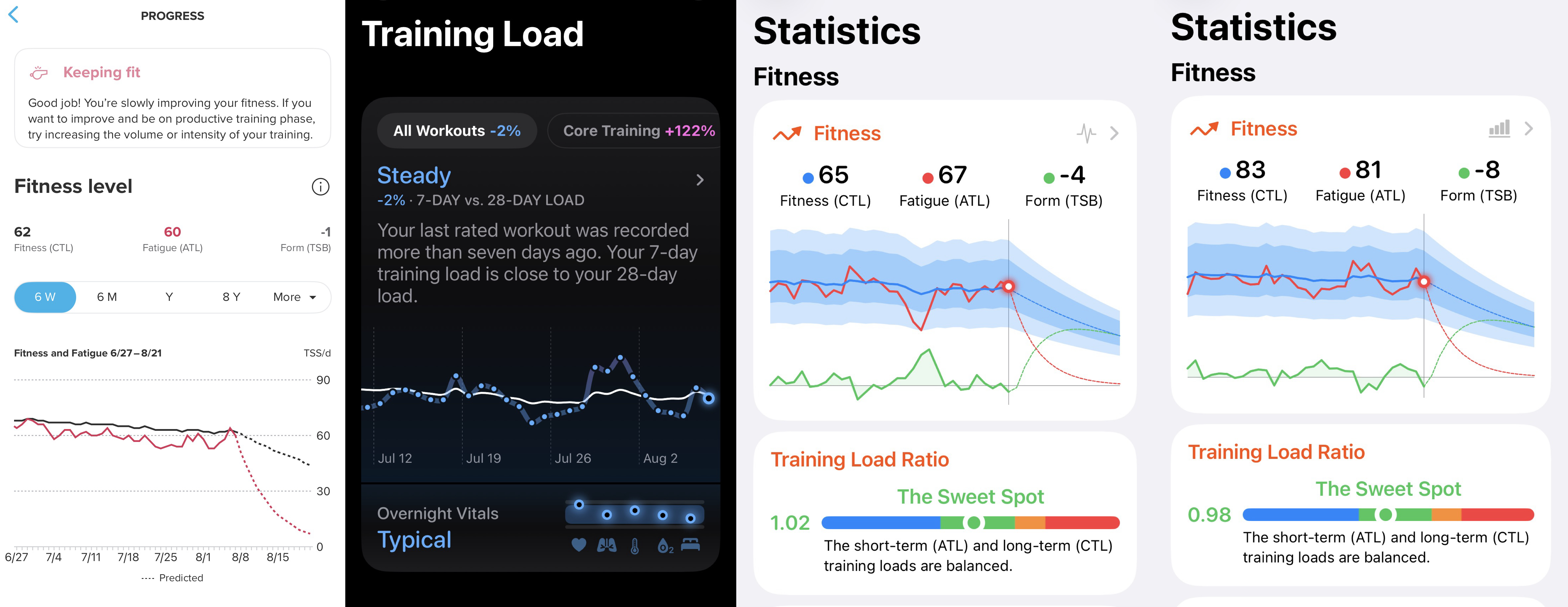
This differs from Apple whose training load metric uses overall time and RPE (1-10 scale). If one wanted to modify TSS based on Feeling, then you’d need to edit and change from the default for the activity (e.g. TSS (hr) and switch it to TSS (manual), then change the TSS value to what you want to modify it as.
I dual record with Apple and don’t bother to adjust TSS in Suunto, except for indoor rowing sessions, where I use the load calculated by intervals.icu as it has access to my rowing power data which Suunto does not. I do compare overall TSB Suunto gives with the iOS app HealthFit, which can show two different TSB scores — one based on HR alone, and the other using RPE, basically giving numerical values to Apple’s training load which doesn’t have a raw score but instead a relative percentage of today compared with history.
From left to right: Suunto, Apple, HealthFit (HR), HealthFit (RPE)
-
@raven Yes, sorry for the confusion—meant the recovery metric.
-
@GratefulDeadpan No worries, just wanted to ensure you were not confused. As for ZoneSense, it can be useful for learning some things, and in general, using a chest strap for running is a good idea anyway.
-
@GratefulDeadpan yea, that is a good question. I do not think feeling emojies are ment to be representing RPE, but I know some people use it for that reason. I personally use it for kind of mark how I felt after excersize, sometimes same workout feels better, sometimes worse since legs are tired or one is mentaly tired or etc.
-
@GratefulDeadpan these smileys after the workout are not really defined but they count into the recovery metric. Therefore, you should use them to track how hard the workout felt compared to similar workouts of the same type/pace. Then when you have a typical training week and you see that you rated it less easy compared to the previous ones it might tell you to take it easier for a bit.
RPE is not anything that you can track with suunto and it is not a recovery metric per se. It is more a metric how hard a session was while doing it. This of course can be influenced by speed or length of the session but also by accumulated fatigue from previous workouts.
Suunto uses TSS as an intensity measure. A TSS of 100 is defined as the intensity of an exercise with 1 hour at your anaerobic lactate threshold. So if you set up your HR at your anaerobic lactate threshold correctly (upper boarder of zone 4), then the TSS tells you afterwards how intense the workout was. It therefore takes out the subjective factor from RPE. But it also doesn’t directly tell you how fatigued you are. But you can use it to compare it again against same workouts. If you for example do the exact same workout the week before and all of the sudden, your heart rate is higher, the TSS value for that workout will also be higher. That might be an indicator of fatigue. But it can of course also tell you if you are getting fitter. So it’s still a little challenge how to interpret the values and needs some experience.
HRM is definitely needed if you want to train with HR and TSS(hr) as wrist is to unreliable. But training with HR also needs correct interpretation and set up of HR zones. -
@mickywickyftw I don’t see how ZS adds anything that you don’t get with HR anyway. For me it is just too inaccurate. I wanted to know how ZS actually performs and analyzed 150 runs and rides that I all did as Suunto recommends for ZS. While the mean reported thresholds over all workouts come very close to my actual thresholds, the standard deviation is at 9 bpms for the aerobic and at 7 bpm for the anaerobic threshold. So therefore on normal runs or rides, I get fluctuations of up to ±9 and ±6 bpm respectively and I never know when it is accurate or not. I had workouts where ZS told me that I am pushing way too hard but my HR was as usual and I was able to do the workout/race exactly as planned. I also had it the other way around. If I would have listened to ZS, I would have had a lot of destroyed workouts or races. From years of racing and training, I know that my HR never differs more than ±2 bpm at the anaerobic threshold and ±4 at the aerobic threshold if I am not completely destroyed or sick. So therefore HR and pace in combination with RPE is way more reliable. At least for me.
-
@brave_dave Doesn’t that just show you that things like thresholds aren’t in fact set in stone and due to recovery status and other daily fluctuations, they can differ quite a bit day to day?
-
@brave_dave Are you sure? Try running in 35°C heat and see for yourself.
-
@brave_dave Are you sure? Try running in 35°C heat and see for yourself.
And I’ll add try running 2 or 3d after a hard race and see for yourself. AT and LT will be wildly different than the values prior to the race if you are well trained and tapered. ZS is real time for effort, I do not use ZS to set my zones as they vary a lot. This has been discussed many, many, many times here.
-
@jussim no, as I said. For me my threshold seems quite stable. I know how high my average HR is over certain distances and then some races it’s 2 beats above that and on others it’s 2 beats lower, but almost never in line with what SZ says and never fluctuates as much as SZ would suggest. My pace of course was sometimes higher even though my average HR was 2 bpm lower and vice versa.
-
@Speed-Man have done that a lot of times over the years. Almost same HR but of course significantly lower pace at same HR. Cardiac drift of course also higher at the end of HM and M races. But until km 17 in HM and 30 in M always in this window of ±2 bpm. 10k and everything below too short for significant cardiac drift. At least with my times
-
@Brad_Olwin I always run 2-3 days after races. Only for all-out Marathons, I take two weeks off. My HR is not really influenced by these races. It is not more than the usual ±4 bpms during easy runs at aerobic LT. Of course my legs are tired and the muscular effort feels way higher for the pace but HR is the same for the speed that I run. I would be then not able to run for long time at my LT but due to fatigue. HR is then still in the expected corridor for that pace. Only experienced strong deviations of LT HR at return to sport after stronger infections like COVID and always the first 3 days of winter training camp on the canarien islands. There my body is always completely overwhelmed by the sudden 25°C temperature difference.
SZ though told me so many times, I would be way above or below my threshold even though HR and pace was exactly as expected. During the training camp SZ always told me that my Real-Time effort should be way higher. No way that I could ever run at that HR which was close to my 1k call-out HR.
Real-Time effort does not work at all for me, while average reported thresholds over more than hundred activities come close.



Hello! It looks like you're interested in this conversation, but you don't have an account yet.
Getting fed up of having to scroll through the same posts each visit? When you register for an account, you'll always come back to exactly where you were before, and choose to be notified of new replies (either via email, or push notification). You'll also be able to save bookmarks and upvote posts to show your appreciation to other community members.
With your input, this post could be even better 💗
Register Login