Battery drain
-
Posting my experience here too. I continue to monitor in my next charging cycle. I have a feeling that the slight drainage increase that I experienced in the last day or so of the previous cycle continues but too early to tell for sure.
Here is my recent battery experience with my Vertical 2.
Over the past 14 days (and a bit) I managed to do 19.5 GPS+HR activities and drain 91% of my battery.
I built a simple prediction model for battery drainage rate assuming that there are three different drainage rates: During GPS+HR activity (running and cycling in my case), during sleep (DND) and while idle (with notifications and raise to wake variations). Under these assumptions I tried to approximate the drainage model as close as possible to the battery levels and activity times I recorded during the day and came up with the following numbers (they imply slightly less than 5% per day without activities and more than the spec 65 GPS hours):
Sleep tracking rate: 0.11%/h
Non activity rate: 0.25%/h
GPS Activity rate: 1.16%/h
Flashlight rate: 20%/hThe above model worked very well during most of the two weeks until the last day or so when the battery got to about 20%. From that point it seems to drain faster than my model allowed. In fact, until that point, the model showed about 1.07% drainage per GPS hour which I updated to the higher number above to compensate for the end.
Settings:
AOD OFF
Raise to wake: Display only
247 HRM
Notifications ON
No external BT connections except Android Suunto App (6.4.7)
Wireless OFF
BT discovery OFF
Brightness LOW
DND from 22:00-5:40
Sleep tracking on with HRM but without SPO2
NO USE OF FLASHLIGHT
-
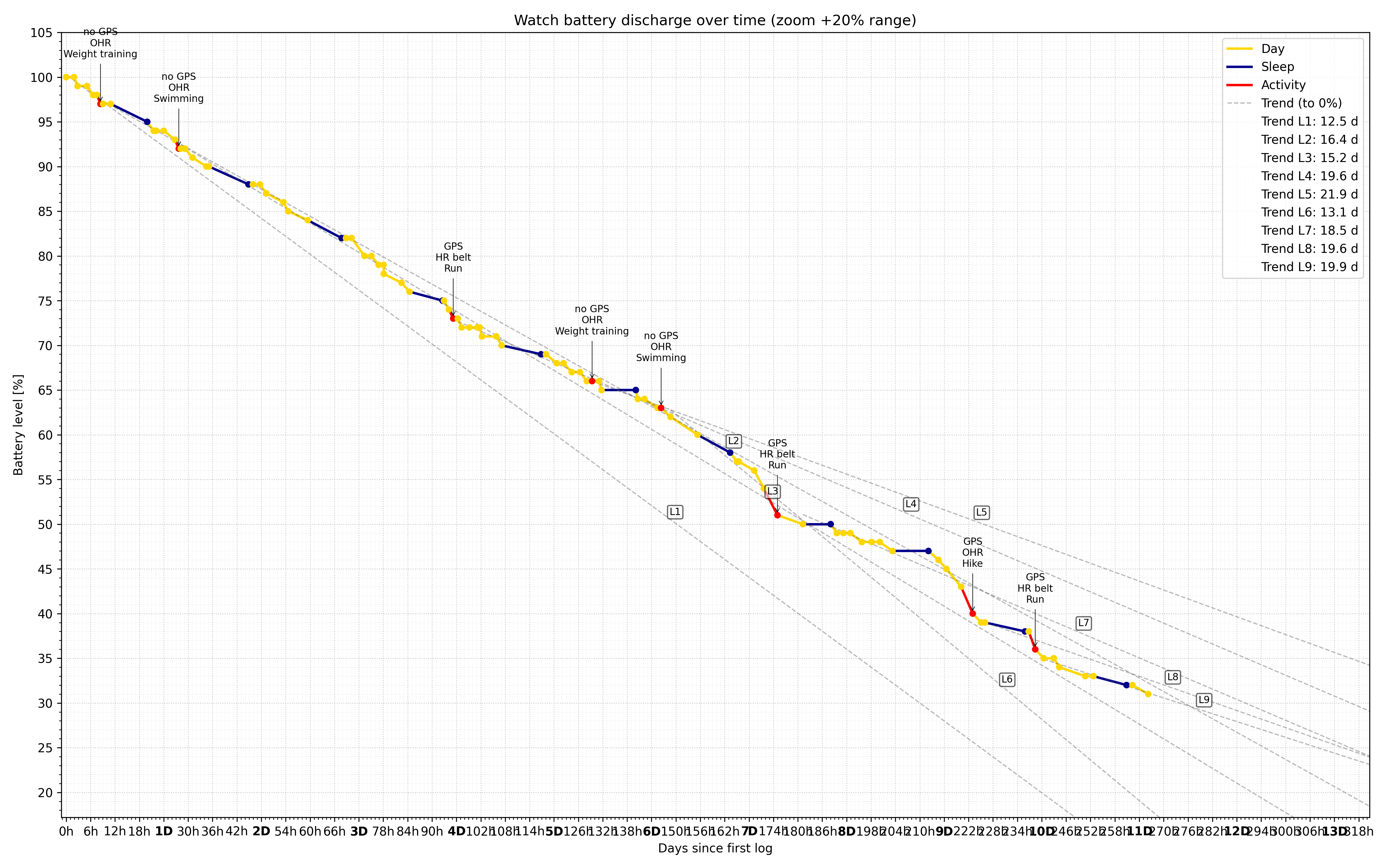
I am attaching a graph from cycle 3.
Since the improvement in consumption in cycle 2, it appears that this trend is continuing and battery life is the same as before.
I conclude that this is due to the removal of the paired chest strap and then a soft reset (holding the top button for 10 seconds).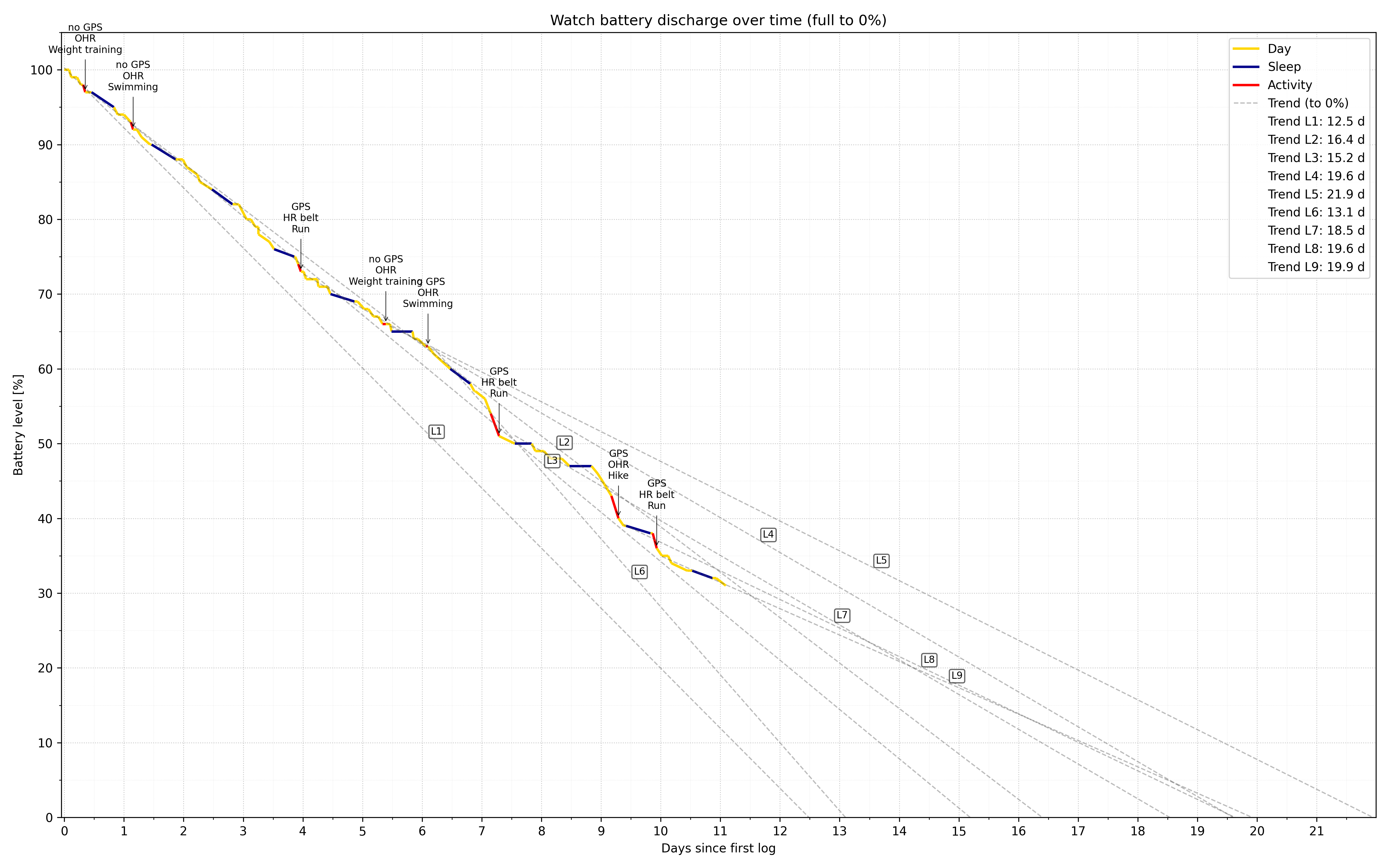
-
@Horizontal_2 said in Battery drain:
sportsmode it’s a bit different. Running 1 hour drains 2 %
Isn’t it supposed to last 65 hours, which should be less than 2% per hour, closer to 1.5%. Even my Race 1 uses less battery per hour. During a recent race It used 27% in 16 hours, and that is in the most accurate GPS mode.
-
@sky-runner AOD, Navigation and I suspect BT to an external device (e.g. HRM) can increase battery drain. From my experience, without the above you can actually achieve better than 65 hours (on V2).
-
@gkaempfer My numbers were with navigation and Bluetooth, but without AOD. I think AOD would have a greater impact.
-
Update on my battery consumption model:
Some of my GPS activities seem to consume relatively more battery than others. In particular, it seems that Mountain biking consumes more than running or bike commuting?
Vertical 2, firmware 2.48.16 ran from a full charge down to 7% in 12 full days with 28:45 hours (!!) of cumulative GPS activity (biking, running, mountain biking).
The corresponding model that was very close to this (and my previous charge cycle):
Sleep tracking with DND rate: 0.11%/h
Non activity rate: 0.24%/h
GPS Activity rate: 1.50%/h
Flashlight rate: 20%/h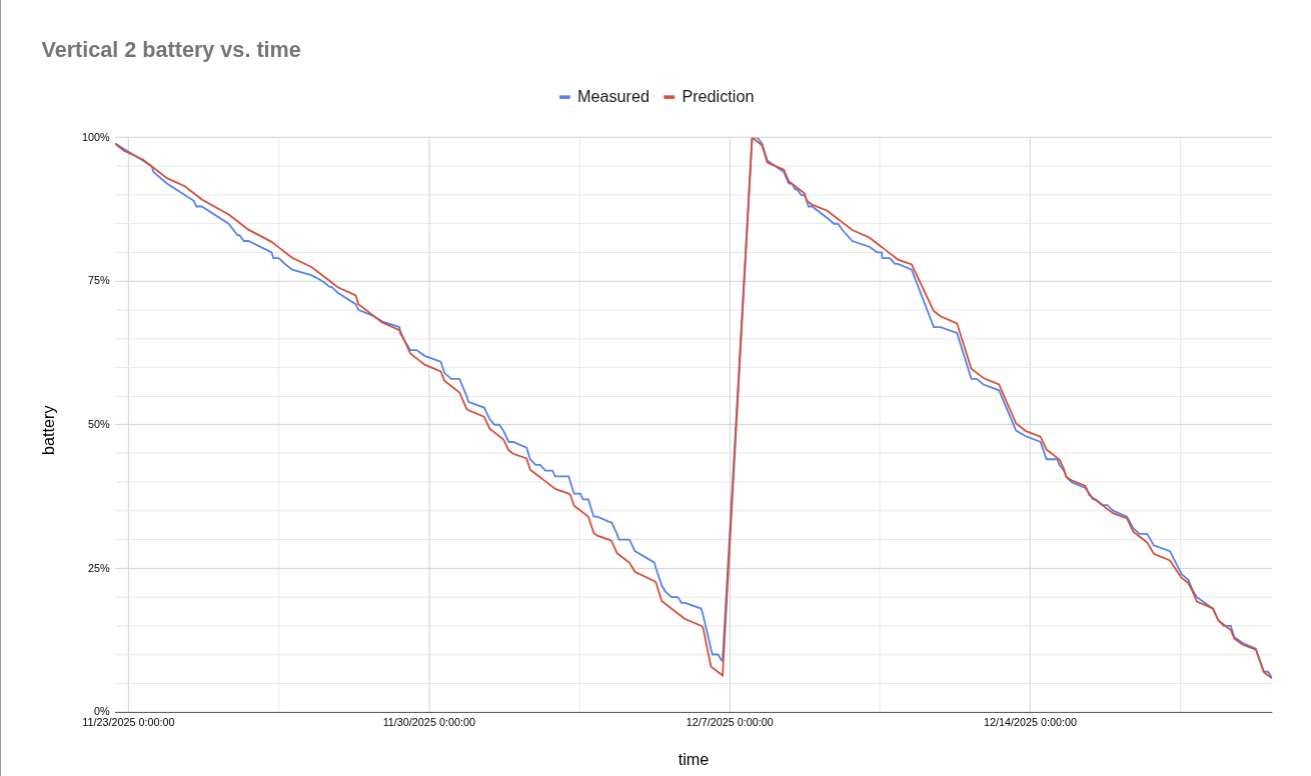
Settings:
AOD OFF
Raise to wake: Display only
247 HRM
Notifications ON
No external BT connections except Android Suunto App (6.5.9)
Wireless OFF
BT discovery OFF
Brightness LOW
DND from 22:00-5:40
Sleep tracking on with HRM but without SPO2
NO USE OF FLASHLIGHT -
I can provide a summary of battery consumption on Vertical 1 from the last cycle (the third cycle).
Mode Consumption Notes Activity 20,492 %/day (0,854 %/h) mainly GPS, HR/OHR, no maps Day 6,794 %/day (0,283 %/h) notification, OHR Sleep 3,959 %/day (0,165 %/h) DND, OHR -
I hear a lot about battery problems, but (fortunately) I don’t think I experienced those.
I use AOD, notifications on, HR on, Simplicity analogue watch face, DnD at night, no sleep tracking. The watch lasts for about a week. E.g. last week I charged on Sunday, did one 6 h Alpine skiing, 2 2h alpine skiing, 1 2h XC skiing (with HR belt) , 5 indoor exercises (HR, but no GPS). On Friday night, the battery level was 30%.
I am not sure what should be my expectations for the battery life, but 6 days with a number of activities using GPS is not that bad.
I am on the most current f/w level (2.48.16)
-
@gkaempfer So, your watch seems fine? You’ve inspired me to create a model. What is your reason you drain it till 7%? I assume it’s not good for the battery life (long term) to drain it that low, isn’t it? My charging strategy is this: drain it till 20%, do a run and charge it when I do have the time.
I’m on my second non-obsessive battery cycle. I’m on day 12 and have about 5,75 hours of GPS-activity (running).
My battery right now: 30%, prediction is 31,78%.
- Model: daily-drain: 0,21 %/h
- Model: training-drain: 1,54 %/h
Things that increased the battery drain:
- Use of flashlight a few times a day
- Use of maps around 50% of the time running.
- I’ve used around one day (18 h) AOD with an analog watch face
- Fiddeling around with Maps and compass. Also use of thermometer in a swimming pool and measuring depths of the swimming pool

Things that decreased battery drain:
- Turned on the Flight Mode (10 h) because I thought the drain was too high.
I didn’t use the HR-belt. I don’t like resetting my watch all the time. I’ll wait for the next update.
So, I think I’m fine as well regarding the specifications! And I do lose my charging cable all the time. I don’t know where it is right now, haha
-
@Horizontal_2 I agree it probably isn’t good for the battery to drain too low. I don’t know what level is best to allow (10%? 20%?).
I try to minimize charging as that is also a process that isn’t really healthy for the battery AFAIK so there is a slight conflict there.I didn’t use any navigation nor flashlight nor AOD. They all consume quite a bit more and at this stage I tried to minimize distortion to the model and setting a benchmark that I found reliable.
Indeed, I think that the result is great. I believe it outperforms any of the competitor watches I considered and with an excellent display when I need it (I would even like it to be less bright in the dark).
The latest model I got is also completely on par with the specs (20 days with OHR without activities / 65 hours of GPS+OHR).
-
@gkaempfer I see the conflict there. But keep in mind this is the advantage of a large battery. Suunto gives warranty for 1 year or 300 charging cycles (300 cycles is something you’ll get in 11 years! Based on a charging cycle of 14 days)
https://www.suunto.com/en-nl/Support/Product-support/suunto_vertical-2/suunto_vertical-2/care-and-support/battery/Influence of the low charge is equal. If you compare a battery which lasts 1 day or 20 days, and you drain both to 0%, the time below - let’s say 20% - is equal.
- For the small battery it’s more frequent, but shorter.
- For the bigger battery it’s less frequent, but longer.
So, I think keeping the battery healthy has more impact by draining it less than charging it less.
Also, I think a 14 day cycle is acceptable and most conveinient if you have a regulary week schedule. So if my battery is 20%, 16% or 14% - I don’t really care, and it’s still an acceptabel percentage to do a run
EDIT: by the way, I don’t think you should be worried about it too much. Probably calander aging is the biggest enemy and we just can’t stop time. The sweet spot would be 20 - 80% charge. But you’ll give up 40% of your capacity (that’s 8 days!) to keep your battery optimal for 20 or 40 years. That won’t happen
-
@Horizontal_2 I agree it’s probably not a real issue to worry about the level at which to recharge. BTW the battery warranty is for one year (and the 300 cycles only if they come earlier).
-
I continue to track battery life with the same settings I used above. This time I managed to get 15 days with 19.75 hours of GPS activities (running and cycling) while the battery went down from 100% to 8%.
During this period I noticed that with the 6.5.9 Android app that had BT connectivity issues the battery drain without activities was less than before. I managed about 3.75%/day (which translates into over 26 days without activities!!). Once version 6.6.3 of the app fixed these issues, usage was probably back to my normal of about 4.7%/day. I guess flight mode is an effective way to save battery life…
I also had some Android updates (Pixel 8 ) so it’s hard to tell what changed.
Anyway, I’m still quite happy with the V2 battery life. Charging once every two weeks roughly is great. It mainly depends on the activity load (during this cycle I was sick for a few days so my average daily GPS usage was low in the first week).
-
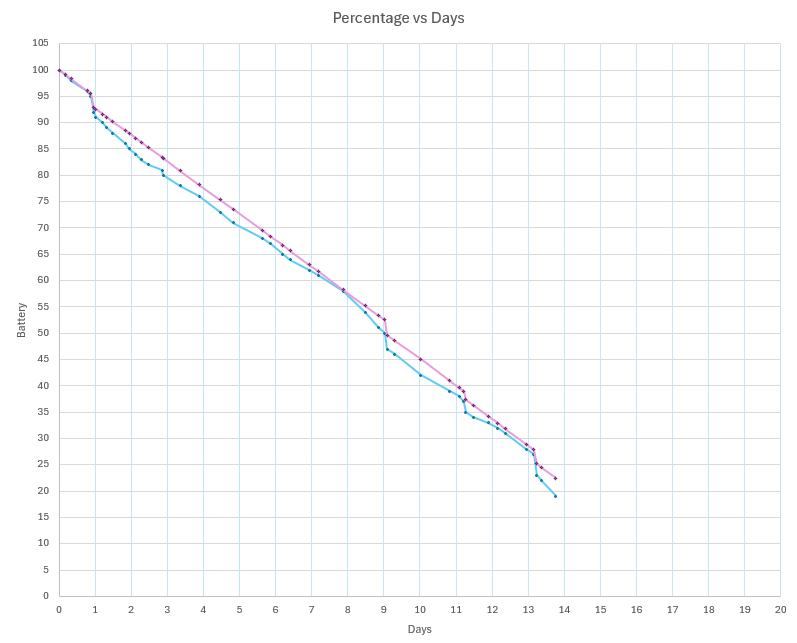
Last one (I think
 ). The blue line is measured. The purple one is the model! It was hard to train during these holidays. There were 6,5 hours of training this 2 week period.
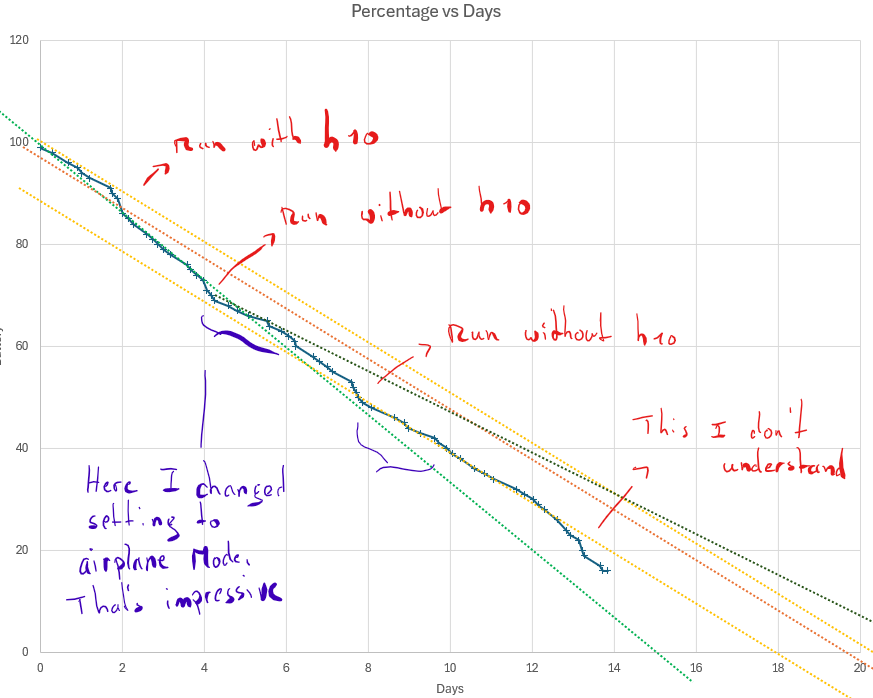
Okay, this is pretty alright. I think the battery isn’t draining linear with the percentage. I’m really satisfied right now! I was a bit down when the battery was so low this morning. It’s on the charger right now
Sometimes it does like there is more drain that expected. After the first run and the last run. I’ve resetted the watch and for a few hours on the Airplane mode.
Other notable things:
- The last run was with maps on ‘light mode’. It’s better visible in snow than ‘dark mode’. It seems to be draining much more battery than dark mode
- I’ve used the flashlight almost every day. One day even for a few minutes. My girlfriend couldn’t read the menu in a restaurant. I can’t see this back in the chart
-
D Dimitrios Kanellopoulos referenced this topic on
-
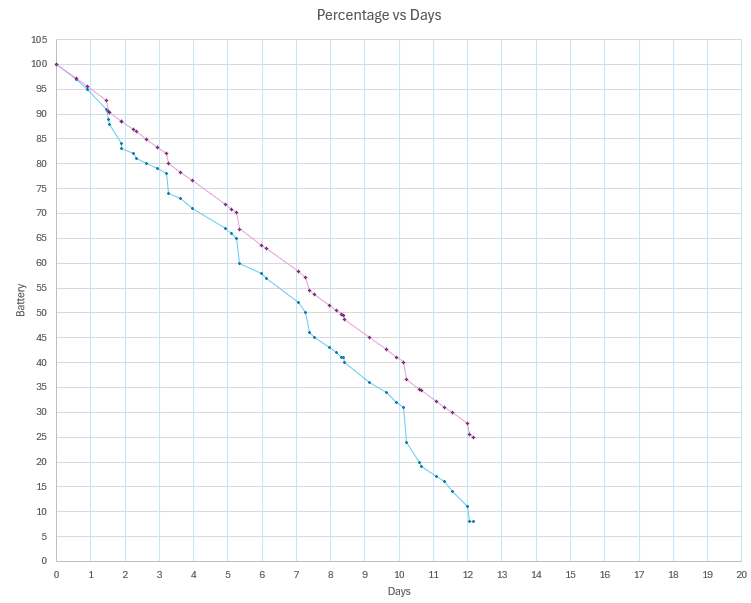
Last one wasn’t the last one. This time it was a bit worse.
Still the H10 seemed cuasing promblems. around day 10 I did a long run with the H10. That caused a lot of drain afterwards. Does anyone else still has that problem? That night I forgot the H10 on my watch. Did a soft reset and swore never use it again

Also many runs drained more battery than expected. Might be due to the many SuuntoPlus Apps + maps. I’ll try running with less apps
.I used the flashlight of the Vertical as minimal as possible. In these 12 days I’ve been using GPS for running for 10,6 hours.
-
@Horizontal_2 I just finished a two week cycle including upgrade mid cycle to the latest hotfix.
I managed to get 14 days with 26.5 hours of GPS (running and cycling) on my Vertical 2.
I’m very happy with that. I used some navigation in runs and almost never used the flashlight. Only OHR without external strap. -
@gkaempfer That’s better than advertised. A 14 days-cycle could be accomplished with 20 hours of GPS.
Is this with the best settings and OHR 24/7 on?
-
@Horizontal_2 Indeed better than advertised!
AOD OFF
Raise to wake: Display only
247 HRM
Notifications ON
No external BT connections except Android Suunto App
Wireless OFF
BT discovery OFF
Brightness LOW
DND from 22:00-5:40
Sleep tracking on with HRV but without SPO2
Some navigation but not during most of the activities (maybe during some 7 activities of about an hour each - easy navigation).
No use of any SuuntoPlus Apps
NO USE OF FLASHLIGHT -
Note that I did run down the battery all the way to 3% before recharging (ran a marathon in the last activity beginning with 8% or so).
It may need to be counted as 13.5 days because I took the watch off the charger at 19:00 and put it on the charger on the 14th day at around noon (so maybe 7 hours before the full 14 days). However, the remaining 3% would have brought me there easily. -
And now I am experiencing an extreme battery drain with Race S.
Yesterday while I was at work it entered an extreme power save mode with 3% remaining, but still shut down a couple of hours later. I recharged it to 92% at around 8 pm last night. This morning, 12 hours later, it is already at 53%. No activities in between!
Suunto: Ambit, Ambit 3 Peak, 9 Baro, Race S, Race Ti, Vertical 2 Ti
Garmin: Forerunner 210, Forerunner 610, Fenix 6X, Fenix 7X Ti




Hello! It looks like you're interested in this conversation, but you don't have an account yet.
Getting fed up of having to scroll through the same posts each visit? When you register for an account, you'll always come back to exactly where you were before, and choose to be notified of new replies (either via email, or push notification). You'll also be able to save bookmarks and upvote posts to show your appreciation to other community members.
With your input, this post could be even better 💗
Register Login