Is there still demand for a modern MIP endurance watch?
-
@Ecki-D. said in Is there still demand for a modern MIP endurance watch?:
Still, I think MIP continues to offer real advantages for an endurance-focused outdoor watch: battery life,
I read the other day, that the battery saving in daylight will be eaten by the need of a backlight in the dark…
Suunto Race S
Garmin Epix Pro -
@2b2bff depending on how you use it. My backlight comes on only when I press a button on my Vertical 1. And that doesn’t happen often.
-
@2b2bff I don’t need a backlight in the dark with MIP Vertical 1, since I’m wearing a headlamp while camping / racing whenever I look at my watch it’s lit up by the headlamp, further saving battery power on my watch.
-
@Ecki-D. I jumped from my loved 9PP to the Apex 4 last Chirstmas. For me, the Apex 4 ticks all the boxes: it basically embodies what a Vertical S should have been. Very happy with the change (bug free, perfect swimming…) , particularly now that the 9PP has been formally dropped from future updates.
-
@2b2bff I use a lot the SV1 in the dark, I do a lots of trail running in the dark and this not really true. I do not have backlight activated, as @brunoh and @litchimonster have said, its is not really necessary to always use the backlight, so, no extra battery consumption.
For me the ideal is the possibility of backlight only in activity with wrist movement for MIP screens, Right now, in the SV, if you activate raise to wake backlight it always works, in all situations, during the day and during activity (I know there is a light sensor but the watch lights up in situations it shouldn’t, increasing the battery consumption a lot). In my experience, if you have raise to wake backlight only in activity, and you do a “speedy” activity, it is better because you see the watch faster and you do not need to point the headlamp to it.
As an example, at home we have 1 SV1 (no backlight only in activity), 1 S9P (no backlight only in activity) and 1 S5P (backlight only in activity), I use the SV1 and my older son used to use the S5P but now uses the S9B and his only complain with the switch was that there was not backlight with arm movement during activity and it was harder to read in dark/night activities. -
@fv4500 Sounds great! Maybe that’s the way to go for me too. I use runalyze a lot and so there won’t be a lose in Training history while switching to coros. I really love Suunto on the other side and who knows, maybe there will be an alternative.
-
In my opinion, there is a place on the market, but only for a relatively small group of people, for an uncompromising outdoor watch, but this is definitely too narrow a group of potential customers for Suunto, or even any other manufacturer, to be particularly interested.
What I mean is MIP, five buttons, the ability to use it entirely without the touchscreen, and full offline functionality – both on the watch and in the app. And clean, intuitive, and responsive maps, compass, as well as the whole interface.
And additionally, a few tools that would be desirable in this type of watch: compass access while following a GPX route or using multiple navigation tools at the same time (currently only one tool can be used at a time); the ability to use routes saved in the Logbook without syncing with the phone; a more intuitive, native Live Track function; night mode (Red light), and increased distance tolerance from the planned route for the Off Route function.
But let’s be honest – the chances of a watch like this hitting the market are slim to none. People actually prefer smartwatches: “scores” instead of precise data for analysis, steps, floors, challenges, navigation like Google Maps, music, payments and other gadgets. It’s a bit like most people who buy Arc’teryx or Patagonia jackets just to wear around the city. And you could say the same about a large group of Garmin users – this partly explains their position on the market.
-
@maszop It looks a lot like like a Garmin enduro 3 no ?
-
@Elipsus Too sluggish and too many “scores” and other smart-nonsense.
Maybe future Enduro 4?
-
I do think mips is superior for sportwatches.
My last watch with mips (forerunner 935) I only had to charge once every 2 weeks (until garmin introduced a bug when they added Galileo support. Since the I needed to charge every week regardless which setting I used)
My 2 last watches with amoled (forerunner 965and race s) both need to charge every 3 to 5 days (with the race s doing slightly better with more accurate gnns settings)
I find mips beter readable. I know the gadgetblogger dcrainmaker assures amoled is perfectly visible, but he makes a picture of the watch in direct sunlight and at home concludes to picture is very clear. But I wear sunglasses , have sweat in my eyes and sunscreen and running in and out shade/direct sunlight. No, it isn’t very visible.
Thankfully the raise to wake works better on my suunto. There is a slight delay but the wake always comes. On the garmin more than half of the time the raise wasn’t recognized. Never had this issue with watches with mip screens.
(Yes, I could turn on aod, but then I have to charge even more. And I don’t want to charge often. Charging is bad for the battery. My forerunner 935 lasted almost 6 years, and I hope my race s can match that)But having said that… it’s the same as with smartphones. There are people complaining they rather have a thicker phone with a bigger battery than an ultra thin phone. But thin phones sell well. So either those people just fell for the better looks of a thin phone or it is just a very small, but loud group.
-
I used LCD and MIP watches for a long time but after switching to AMOLED I am not going back. Yes, it is nice to have always on display in some situations, for example when riding a bike, but at least for running and similar activities the wrist activation works well enough.
When an MIP display is combined with sapphire crystal there are reflections and the contrast is too low, and it makes it difficult to read with my aging eyes. It is especially difficult for the eyes on a map screen with a lot of fine details in a condition with not very bright diffused light or in a condition with variable light with patches of sun like in a forest. I agree that MIP displays are great in direct sunlight but unfortunately for me it is relatively rare for me to run in a high alpine environment with strong sunlight and much more common to run in a forest.
AMOLED displays are much easier to read.
-
I’ve compared the MIPs of the Suunto V1, Coros Apex 4, and Garmin Fenix 7.
I used the Fenix for several years.
I switched to Suunto V1 and have been using it for over a year now.
I tested the Coros Apex 4 for one week.
In my opinion, the Coros has the worst MIP out of the three: it’s the least visible indoors. It’s no better in sunlight when compared to the Garmin, let alone the V1—it’s simply too dark among the three. That’s why it has a white face enabled by default, so it’s more visible during the day and in marketing photos.
Apparently, Suunto uses an LED under the screen in the V1 to illuminate and brighten the display. Someone needs to confirm this, but I read it somewhere—I think on Reddit.
I think the V1 has the best MIP display, whether with white or black faces/fonts. It’s clear in all conditions and has 3 brightness levels. Garmin does too. Strangely, Coros Apex 4 doesn’t have brightness adjustment at all.
Edit:
For every watch I’ve used, I’ve gone with the version that has sapphire glass, which supposedly makes the display harder to read but improves durability. Apparently, that’s why the Coros Apex 4 is such a piece of crap. Suunto managed to pull it off—apparently because of the LED under the screen.
-
I agree with @maszop but not with a MIP screen because I agree 100% with @sky-runner . What I would love and probably a very small group of people. Make a Suunto Vertical Pro with an AMOLED screen and no OHR. I don’t want OHR and don’t need it. Make the watch a bit smaller (only height so 12mm or so) keep the battery size of the Vertical 2 or bigger. Without the OHR module and the battery drain from the OHR I imagine a watch that is not as bulky but that matches the Vertical 1 Solar for battery life. Make the VP watch as light as possible and we have a true outdoor/mountain expedition/ultrarunners watch. I asked for this awhile ago and I think the cost would far outstrip the user base.
Vector/T6c/Vertical 2 Ti
-
@Adrian.S interesting wouldn’t tell that Apex 4 screen is worse, for my eyes it is even better than V1.
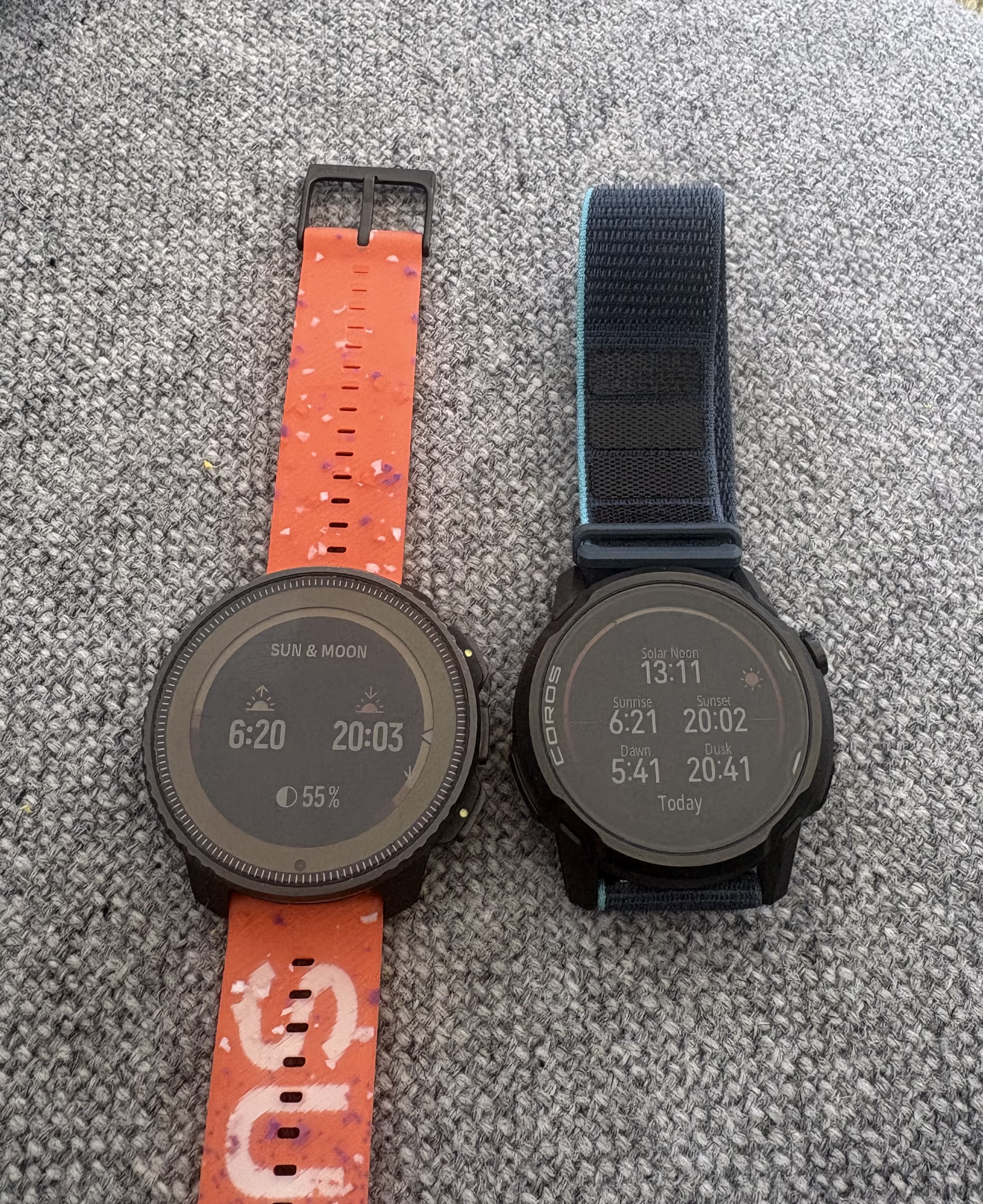
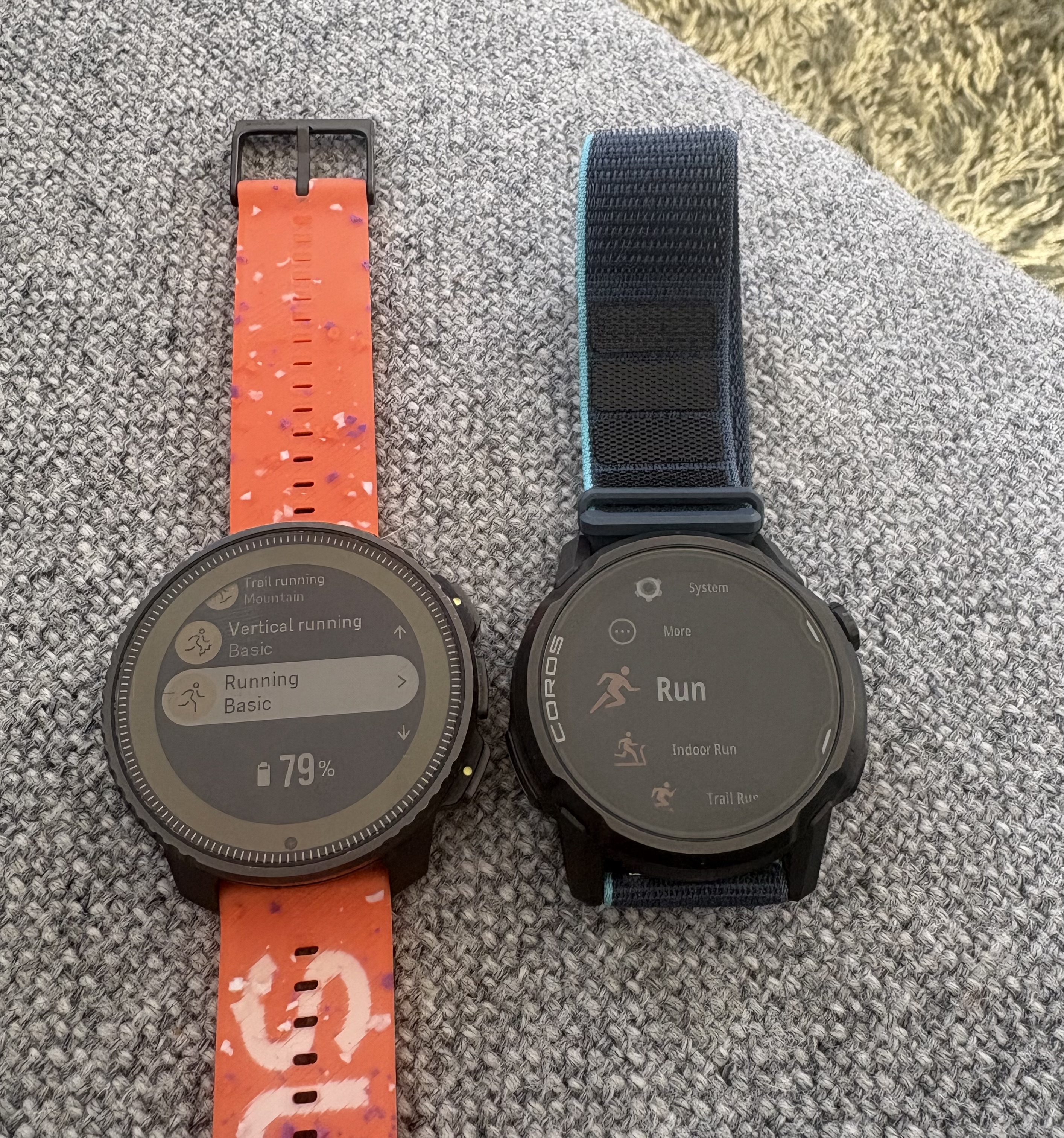
Both with backlight off. Seems quitr similar in the picture. I guess it depends
 I guess in my case the reflections are stronger on V1 screen than on Apex4 therefor it feels worse.
Suunto Race 2 (Titanium Trail)
Suunto Vertical (Titanium Solar Forest) -
@Brad_Olwin As is turns out, I prefer AMOLED too, but I was writing about a watch that is uncompromising and somewhat niche. MIP – maybe even with Solar – still offers the longest battery life and is perfectly adequate technology. That would be exactly the kind of standout model for special use cases. And despite being niche, there’s actually a large group of people who miss MIP. But for me, the Vertical 2 is the better option.
-
I compared them during my runs trail and in mountain, not in photos taken with phone.
Also, from what I can see, it looks like your backlight is turned off when you take a photo.
Also, from what I can see, it looks like your backlight is turned off when you take a photo.
I also don’t know what brightness setting was used when the photo was taken. I’m guessing it was set to low—switch it to medium or high—and the readability of your Suunto MIP will definitely improve, not only outdoors but especially indoors.
-
I’d argue that if you’re just using the watch during activities, then either display is fine. The latest AMOLED watch I tried was the AWU2 and it was plenty bright to see in all conditions. And, yeah, maybe it was even a little better in dappled forest light.
The problem for me, though, is that 95% of the time I’m not recording an activity and I want my watch to look and function like a watch. AMOLED needs to emit light to be seen. And it’s a harsh, direct light at that. MIPs rely on reflected light, exactly like a regular watch (and every other thing in life that’s not a screen or lightbulb). I very much prefer this over a large, black circle on my wrist.
I also just don’t like to flick my wrist to get info. Most of the time I glance at the watch at off angles. Can’t do this easily with AMOLED (yeah, I know, AOD). This is also a problem when mounting the watch on bike handlebars.
@brad_olwin I’m with you. I’d love to see a slim-downed Vertical Pro without OHR. Just make it MIP.
-
@Adrian.S sure, photo was just an example, I compared them in runs also, my reflections are from runs. Backlight does not change anything midle of the day, I keep backlight off on Apex4 throughout the day. Still I think reflections are worse on my V1. Again I have Apex4 just for week or two and most of my runs were in bright daylight, might be that in other conditions it sucks. But again might be too small of a difference to notice, I just did not agree that Apex4 is crap when it is almost the same, peace. I love my V1 regardless

-
After few months with Race 2 and previouse owning of Suunto 5 and Ambit 2 here is my opinion.
Amoled has great colors and great refresh rate. But thats it.
Benefits of MIP for me:
It always show time, no need for specific rise to wake move. Even slight move of hand wakes watch and i can see full watchface. This was great in day to day use when working etc.
In night with low backlight is not so agresive agains eyes compared to bright amoled even on low brightnes.
In sport modes always visible even on bike handle no fallback to limited AOD.
In daylight great visibility without higher consumption of battery as MIP doesn’t need any backlight during daytime.I buy watch once in a while so since i bought Race 2 lately. I am not interested in any new model MIP or Amoled in next 5 years. But than if available i would prefer MIP version over Amoled but only if all other spec of MIP watch was same.
Suunto Ambit 2 > Suunto 5 > Suunto Race 2
-
@Brad_Olwin The early fenix models had the options to be sold with or without HRM, but indeed, i don’t think there is a market anymore for sport smartwatch without HRM, the convenience factor is just too good









Hello! It looks like you're interested in this conversation, but you don't have an account yet.
Getting fed up of having to scroll through the same posts each visit? When you register for an account, you'll always come back to exactly where you were before, and choose to be notified of new replies (either via email, or push notification). You'll also be able to save bookmarks and upvote posts to show your appreciation to other community members.
With your input, this post could be even better 💗
Register Login