Suunto ZoneSense
-
@matram @atoponce yes, that is also in line with my data. The fluctuations between different runs/rides are way too big.
Sometimes it comes close and then again it’s way off…On average for me, too inaccurate to rely on, especially on individual workouts/live-readings.I mean it makes sense looking at the scientific publication on ZS/DDFA. The method was scientifically developed/tested on a stationary bike/treadmill with constant intensity increases every 3 minutes passing both thresholds. Even under these lab conditions, the accordance to lactate testing was okish in my eyes.
Typical real-life workouts probably just add even more noise through fluctuations in speed and terrain etc.
-
@raven A full ZS graph from the beginning on for every workout is technically not possible for this type of ZS/DDFA implementation that Suunto wants to have.
Suunto argues that with ZS you get an intensity measure for every individual workout. To do that, the method needs a below aerobic threshold intensity for the first ~6-10 mins to set a baseline DDFA value. Only after this low intensity time, it can set the daily/workout-specific baseline and then calculate the intensity regarding to the baseline.
So therefore it cannot give you values during the first few minutes. It could only do it by using historic baseline values but then it would not be a daily/workout specific measure anymore.
Another way would be to implement it in the post-workout analysis by prolonging the set baseline also to the baseline-calibration period. But then one would only get it retrospectively and not live how they aim for. -
@raven A full ZS graph from the beginning on for every workout is technically not possible for this type of ZS/DDFA implementation that Suunto wants to have.
Suunto argues that with ZS you get an intensity measure for every individual workout. To do that, the method needs a below aerobic threshold intensity for the first ~6-10 mins to set a baseline DDFA value. Only after this low intensity time, it can set the daily/workout-specific baseline and then calculate the intensity regarding to the baseline.
So therefore it cannot give you values during the first few minutes. It could only do it by using historic baseline values but then it would not be a daily/workout specific measure anymore.
Another way would be to implement it in the post-workout analysis by prolonging the set baseline also to the baseline-calibration period. But then one would only get it retrospectively and not live how they aim for.My thought/hope is it could use historic values if they are recent (say last week/month) to give a “temporary” score for those first ten minutes live, while concurrently doing the calibration it does now, then in the session record “correct” those ten minutes if needed. Absent injury or illness, my recent historical data, while not perfect, might be able to at least give an estimate, while right now you get nothing.
Or even just don’t show me live, but give me the full graph afterward. Once it does the calibration, doesn’t it have the necessary info to figure out what the first ten minutes was?
As it is, I’m planning to test a Garmin device for their “stamina” feature, which of course is not the same thing at all as ZoneSense, but may actually be more useful for some of my interval use cases: https://www.garmin.com/en-US/garmin-technology/running-science/physiological-measurements/real-time-stamina/
My hope was that ZoneSense could help me judge pacing my recovery/work efforts in interval settings more than just relying on raw HR numbers alone, and it can be useful, but only if I properly do what ZS wants the first ten minutes, and if I do a “stack” of multiple sessions it needs to be redone each time, so three sessions in a day is 30m of repeated calibration time.
I don’t hate the feature, but it’s limited in what I can use it for, and at this point, I feel I’ve learned enough from it I don’t necessarily require it anymore. As I use a chest strap anyway I continue to get those values but it’s proving less relevant to me over time.
-
@raven yes, in theory it could take historic baseline settings and aquire them retrospectively to the first 10 minutes. The problem is that ZS/DDFA calculates something like “mean” beat-beat times for a rolling intervall to smooth out fluctuations and observe the trend. In the publication from Kanniainen et al. 2025 (that ZS is apparently based on), they define this intervall as 320 heartbeats. So therefore for every workout it needs these 320 beats to get a reading even when it uses a previous baseline. This could be then approx. 2-3 minutes.
But yeah, in my experience ZS applicability is really limited as it needs pretty smooth values that you usually don’t get during real-life workouts. But it was also not developed and has so far not scientifically been tested for that purpose.
So Suunto so far makes unproven claims…
But so far no-one has a better approach then lactate testing to get threshold according to HR.
So I would forget about all these voodoo functions from Suunto, Garmin… -
As it is, I’m planning to test a Garmin device for their “stamina” feature, which of course is not the same thing at all as ZoneSense, but may actually be more useful for some of my interval use cases
I never used real time stamina on my watch. I only have seen it afterwards in the stats. I remember a particular long run about 20km. I felt it getting harder at about the 17km mark. That is where Garmin said I only had a stamina of 1 left. But I still could run and get home without being totally exhausted.
TBH, how would you use it in a race? If it declines faster than the end of the race, do you dial back the effort? Maybe possible on flat terrain, but what if there is elevation going on?
-
I never used real time stamina on my watch. I only have seen it afterwards in the stats. I remember a particular long run about 20km. I felt it getting harder at about the 17km mark. That is where Garmin said I only had a stamina of 1 left. But I still could run and get home without being totally exhausted.
Garmin Stamina one of those features that I found to be useless in reality. In a 30+ hour ultra the stamina dropped to nearly zero in 10 hours, and yet I continued to run for another 20 hours. It might work correctly for a typical runner in a short run, but it definitely doesn’t adapt to ultra running. In general, none of Garmin metrics work well for ultra or trail running.
But similarly, Suunto ZoneSense has never worked for me. I stopped paying attention to it.
-
I never used real time stamina on my watch. I only have seen it afterwards in the stats. I remember a particular long run about 20km. I felt it getting harder at about the 17km mark. That is where Garmin said I only had a stamina of 1 left. But I still could run and get home without being totally exhausted.
Garmin Stamina one of those features that I found to be useless in reality. In a 30+ hour ultra the stamina dropped to nearly zero in 10 hours, and yet I continued to run for another 20 hours. It might work correctly for a typical runner in a short run, but it definitely doesn’t adapt to ultra running. In general, none of Garmin metrics work well for ultra or trail running.
But similarly, Suunto ZoneSense has never worked for me. I stopped paying attention to it.
Thanks for the report on that. My use would be interval work, things like doing repeating 800m and deciding whether to stop after four iterations or six, etc.
-
I wonder if @brad_olwin is still using it or not
-
I wonder if @brad_olwin is still using it or not
He is! I primarily use it for the AT boundary and not the LT boundary. I only trust the estimates ZS gives me on Zones if I do a hard workout where I transit across all zones. Tempo workouts provide AT and LT numbers that are close to my test values. I do not change these and have found them stable. I do however use ZS for my easy runs to make sure I absolutely stay in ZS1. For races, I use ZS and try to limit my time is ZS 2. I try very hard not to enter ZS 3 during a race (ultra).
My predicted zones do bounce around especially with easy runs so I tend not to pay attention to the suggested zone boundaries unless I am doing harder workouts but as I said earlier the estimates have been stable for me on the hard workouts, not the easy ones.
-
@raven I agree with @sky-runner on Garmin Stamina. An hour or two into a 50k race my stamina is 0 but I was able to go another 4-5h at the same effort and finish the races within 6-7h. When I had a Garmin watch I replicated this several times.
-
@raven I agree with @sky-runner on Garmin Stamina. An hour or two into a 50k race my stamina is 0 but I was able to go another 4-5h at the same effort and finish the races within 6-7h. When I had a Garmin watch I replicated this several times.
Yeah, seems long endurance efforts isn’t the strong point. For me that’s fine. I may do one 20km-22km effort a year, and most of the time I’m doing either 5km or 10km overall efforts. When possible, I like to get time on track and do interval work with 100m, 200m, 400m, and 800m targets, and recoveries in between.
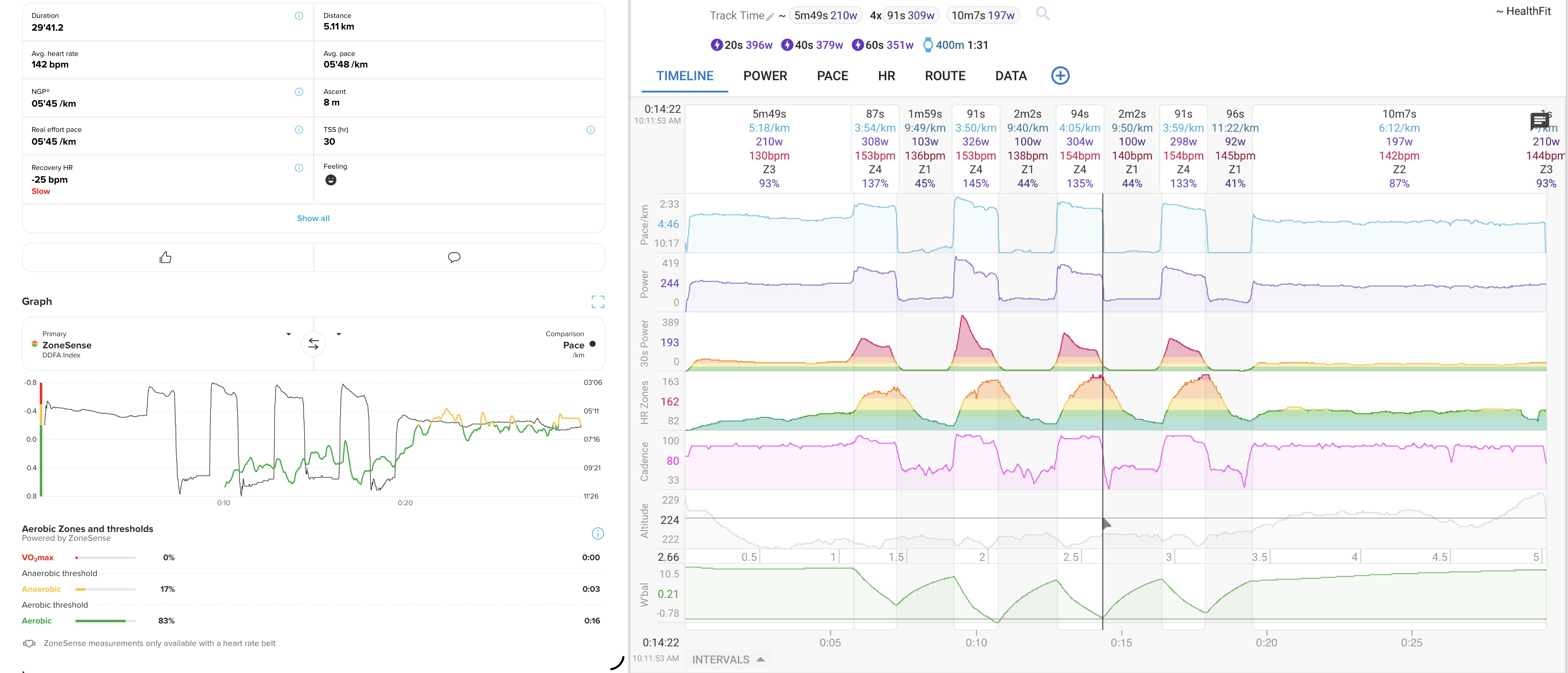
This is where ZoneSense might not even register at all for a shorter interval; I might do 200m at 3:30/km, then switch to a walk and see the entire time was “green” as the effort wasn’t long enough. That’s not a slam on ZoneSense; it’s not what it’s meant to do. I’m curious if situations like that might actually register with Garmin’s Stamina or not. Post-session, I can model workouts on intervals.icu and see W’bal effects when I go above my running FTP, but during session there’s no real tool for this I have at the moment. Here’s an example (4x 400m) with Suunto/ZoneSense on left, intervals.icu on right:




Hello! It looks like you're interested in this conversation, but you don't have an account yet.
Getting fed up of having to scroll through the same posts each visit? When you register for an account, you'll always come back to exactly where you were before, and choose to be notified of new replies (either via email, or push notification). You'll also be able to save bookmarks and upvote posts to show your appreciation to other community members.
With your input, this post could be even better 💗
Register Login